Written by Ted Goslin
The following is the second of two parts on what it’s like to experience Panorama in Trinidad for the first time. Click HERE for Part 1 of the story.
Playing competition music in a large ensemble is an unusual beast. It’s like hunting with a pack of wolves. Keeping the pack on the scent of its next kill is easy enough when the scent is present. But what happens when the scent is temporarily lost on the trail? There are a lot of distractions on the way to a meal.
What I respect about arrangers like Andy Narell the most is the patience they must possess to deal with the frustrations of keeping a large, 90-player group, on track to perform one song perfectly. True, it’s just one piece of music, but it’s one epic, challenging piece, requiring a surprising nuance and touch that will test even the best of players.
Aside from this year’s piece being more melodically and harmonically rooted and less based on break-neck runs than most typical Panorama tunes, Narell asked for certain touches throughout the piece that some players weren’t expecting. The guitar section, which consisted of double, triple and four-cello variety, had particular trouble with dynamics (controlling the loudness of the piece).
Although there were many players who were able to follow directions well, there were just as many players (particularly the less experienced) who played the piece as hard as they could the whole time without any delicacy of touch. That’s not to put blame on them or call them out in a negative way, but more so to comment on how unusual this style of playing was to those players and how it reflects the direction Narell chose to take the band. Nonetheless, with enough repetition, the players got it together with dynamics. But that wasn’t the only downed-tree on the trail.
“I’m happy with the composition, and was pleased with the performance, given the circumstances. We had so few players the first two weeks of January that serious rehearsals only really began the Saturday when the foreign contingent showed up, which was eight days before the semi- finals,” Narell said in retrospect. “Then I had to slow the band down so that late arriving local players could learn the music. One of the positives that came out of that whole experience is that we are working on a model for future steelband performances and festivals. I think everybody who was there the day that the foreign players walked in and played the whole tune from start to finish on the first try—and sounded pretty good—was seeing a glimpse of something we will be doing a lot more of in the future, and not just for Panorama.”
As is the nature of the competition, most local players are used to playing in multiple groups for Panorama, often skipping one rehearsal to learn the tune of another band. This is mainly due to the pay given to players by PanTrinbago, the governing body of Panorama, for playing each band at the event. Considering the competitive nature of the event, coupled with the need for more income due to limited employment options, players would show up late during the week to learn the piece, only to slow rehearsals to a crawl. Narell, being the seasoned, patient arranger he is, paid no mind to this as it’s become an expected part of the process to reteach parts. Thanks to his calm demeanor and the help of other players coming in in off-hours during the day to conduct sectionals for struggling players, the kinks were worked out as the week moved ahead.
After the prelim performance, and a good night’s rest, we were treated to a morning masterclass for the ages with Lord Relator and Andy Narell taking us through the history of Calypso music, performing, rather than talking, through said history. What really grabbed my attention during that session, besides the music, was the reaction from the birdsong staff who poked their heads in and out throughout the morning, while performing their duties to the facility. One highlight that caught my eye occurred towards the end when Relator asked the audience to present him questions that he would answer with Extempo, which is the OG form of freestyle rapping in Calypso music. He was asked to perform a classic piece (of which is a blur to me now), which turned into a sing-along with those who knew it. It told me and the rest of the attendees how important Relator, and Calypsonians in general, are to T&T culture.

Trip To The Yards
Despite the excitement that filled my every waking moment during the trip, fueled simply by ‘being in Trinidad for Panorama,’ I couldn’t help but have a growing anxiety for wanting to visit other band’s panyards, particularly Phase II Pan Groove, one of my favorite bands growing up. Luckily, thanks largely to the collective powers that be all sharing the same sentiment, I got my wish as a Maxi bus was commissioned for Wednesday evening, the night after our preliminary performance, to tour some of the remaining preliminary band performances, including Phase II.
A bus was needed, not just for the number of players who wanted to go (which were pretty much all of the foreign players), but due to the bands all being located in and around Port of Spain, about 30 minutes away. As mentioned in part one of this piece, the judges segmented their visits by region, handling our region on the first night, and ending their tour on the second night with bands in Woodbrook, St. James and other areas around Port of Spain, located on the North Western part of Trinidad.
Since many of the bands we were planning on seeing had already been judged (Renegades, Silver Stars, and Trinidad All-Stars, among others), we were forced to visit the two remaining bands being judged in the area that night. Much to my and others’ surprise, those bands were the legendary Invaders Steel Orchestra and (you guessed it) Phase II, which was the first stop.
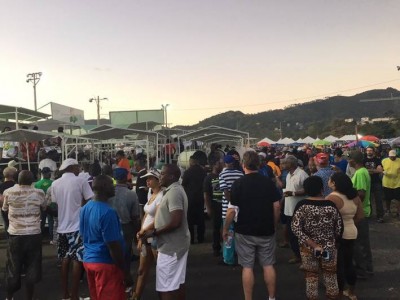
As soon as the bus let us off, I felt energy. Of course, it came from myself and my companions, but even more so, from the people filling the streets, walking to the yard. It was a spectacle. I thought the number of people walking to the yard was astounding, until I saw how many filled the yard itself. It was wall to wall.
Part of the fun of going there, and other yards, is seeing how they are laid out. All yards are pretty different, which seem meant to represent the band culture and personality by design. Phase II’s yard was located at the end of a street, with the entrance feeding from the street into a short walkway area into a large cement zone where the band set up. To the left was a building where snacks, drinks and merchandise were sold. The band was roped off with yellow tape to keep the area in front clear for photographers, officials and the band leader to work. The leader and arranger of the band on this night and for the past 30-plus years was the great Len “Boogsie” Sharpe, an icon of the instrument as both player and composer.
As I approached the tape, I knew I had to find a way through to talk to him. Aside from wanting to ask him for a potential interview, I wanted to reconnect from a previous encounter we had. When I was about 16, I had the privilege of playing a memorable concert with “Boogsie” in Long Beach, Calif., with my band, PANic, led by Chris Wabich. But that was in 1997. I hadn’t seen him since.
The perimeter was guarded by guys in yellow shirts, who seemed to be security of some sort. However, the closer I got, the more I realized, they were really only there to keep out rowdy people, as he didn’t pay any notice to me as I snuck under the tape right next to him to enter the performance space. I quickly introduced myself to the first person I saw, noted pannist, arranger and band member, Natasha Joseph. After a brief chat, I made my way to Sharpe, who had his back turned. As soon as he turned and saw me a wave of recognition swept his face. He remember me. This was significant, not from my dorky, pan-geek fanboy perspective, but because it had been nearly 20 years and he recognized me from our concert. I had also met him once before then, so that could have helped his memory, but still. It made me wonder what the extent of his mental capabilities were beyond just music. I related that thought to the other genius arrangers in pan and what their capabilities might accomplish had they chose to be lawmakers or doctors. That said, I’m still glad they chose pan.
After our brief encounter, I took a tour of the yard, seeing a grass area behind the bass section at the read of the band where people were mostly just hanging out and drinking (among other things). Once I made it to the other side, I searched out my friend, Johann Chuckaree, another popular pannist in Trinidad who happens to play tenor in the front line. After we exchanged pleasantries, he informed me that he wasn’t performing with the band that night, having been focused on helping the Renegades, who were performing an arrangement of his original composition, “In De Yard.” He would play with Phase II again in finals, however.
As if it weren’t enough to meet those three prominent pan figures, the band then performed. I’ll tell you, as a music-lover, whether you’re into steelpan music, rock ‘n roll, hip hop, classical or jazz, there is no greater feeling than getting to witness one of your favorite bands play live for the first time, especially if you are only about 20 feet away from them, as I was. As they blasted through Sharpe’s bluesy, jam-filled arrangement of his own piece, “Madd Music,” I felt of piece of myself fill with ecstasy, as if for my soul to say, “I’m good now.”
After the band finished, we left the yard and walked to the Invaders panyard, only a few blocks away. The yard had a different feel, being much smaller, which forced many onlookers to stand outside the gates, looking in through the perimeter fences. It wasn’t as easy to speak to the arranger this time as I wasn’t allowed to speak to anyone until the performance ended. That was more of what I was expecting, but I guess all yards are different.
Once the band played, I started to see what other saw in this legendary group: a youthful passion, rooted in history. What makes the band special is that it was formed by Dr. Ellie Mannette, the inventor of the modern steelpan. The band also gave birth to the genius of Ray Holman, who left to arrange for Starlift in the 1970s. Anyone familiar with the musical threads that make up each band know the difficulty that an arranger faces when they take over a band from someone who helps form that sound. Arranger Arrdin Herbert did well with this, however, as he got his band into finals, eventually placing fifth overall.
Once the band finished, we re-boarded our bus, all high with excitement and energy from the evening’s events. If we thought just being there was exciting in itself, seeing those bands in action easily topped the trip to that point. Later we’d learn, that was just the tip of the ice berg. As said by famed 1970s rock band, Bachman Turner Overdrive, “Baby, you ain’t seen nothin’ yet.”
Welcome Guests
 While the hard work myself and the rest of the band put into perfecting the arrangement was well worth the effort, part of the experience was in the lime during breaks. Rehearsals would generally start around 7pm and end around 11pm, except the night before semis, which ended around 1am (mainly to get us prepared for playing so late, given our spot going on last).
During breaks, players would go off on their own, usually to the bar down the street for a quick beer or cigarette, or both, and chat about the day’s events with other players. What stood out the most to me were the random visitors we would get, including my neighbor Monica and her friend who came to say hi.
Lots of fans of birdsong would appear throughout rehearsals, walking around the band and observing up close, or just sitting on the bleachers and taking in the arrangement, regardless of what section was being performed that night. I’d learn later that most bands don’t perform the whole piece until the night before semis, both to not give anything away to potential spies and to help the band focus on the most difficult sections, building the arrangement one piece at a time.
Food vendors would also appear, bringing such things as doubles, roti and sodas, while one man, who we only knew as “The Peanut Guy” sold fresh, warm nuts (yes, I know how that sounds), which came in handy as snacks during the longer rehearsals.
Then came some celebrity visitors (in the steelpan community, that is). One of the first to arrive was Emrold Gray, more commonly known as “Mallet Man”. Gray, who lives in Baltimore, is a native of Trinidad and sells craft mallets, which have become popular among many top players, including Andy Narell and Dr. John Wooton, who both use Gray’s mole skin-tipped mallets to give them a softer, more melodic tone when playing.
Despite trying to remain incognito, Gray was swarmed by a cluster of pan players looking to upgrade their mallets, knowing he had some of the best on the market. Luckily for him, he came prepared, complete with a mallet-packed backpack, of which I purchased a handsome pair for myself.
During one conversation between Narell, Patrick Fitzgibbon and myself, we were interrupted by the arrival of Ray Funk, a noted historian of all things Calypso, including steelpan. Funk is a retired Alaskan judge who visits Trinidad regularly to take in various national events, including Panorama.
I had the pleasure of speaking with him briefly about what Panorama means to him and how he feels about seeing the bands perform. “It’s all great,” he said. “Every band is so wonderful, I’m just happy to be here.”
The celebrities didn’t stop there. Mia Gormandy, a doctoral candidate in ethnomusicology through FSU (Florida State University), pan virtuoso and soon-to-be first-time arranger for birdsong at 2017 Panorama, stopped by to check out the band and chat pan with me for a minute.
“I’m in Japan looking at steelbands for my dissertation. They have over 30 steelbands,” she said. “My goal with steelpan is to really start job opportunities. Let’s say someone wants to pursue pan as a career, it’s very difficult. There are only so many positions, like in the U.S. education system, where there are people who are given positions to teach pan but who have not studied pan.”
She went on to explain Trinidadians sometimes take the instrument for granted. Since it’s everywhere, they forget what it takes to make a career out of it, and don’t always give players and bands the support they need. Although it’s the opposite problem in the U.S., we reminded each other of the importance of community becoming one on a topic to help move an idea forward. In the U.S., positions are given to those who might not be the best fit for a steelband. But there is a remedy that some are working on to help spread the word of what it takes to make a pan program successful.
“Chris Tanner, Mike Wendeln and others are working to create a steelpan association to help spread awareness about pan in education. Once an organization like that becomes popular enough, and people become aware of it, when a school is hiring for a steelband position, they’ll say, ‘Oh wait! There’s a steelband association, let me find out more.’ It’s an education thing. People just need to be aware. We as pannists need to promote it.”
 Tour of Pleasures
After rehearsal, Mia was kind enough to invite me on a tour of panyards with two other pannist friends of hers. We drove back to Port of Spain and stopped at a couple yards that had just finished for the evening before making it in time to catch Silver Stars hard at work.
The Silver Stars yard was fascinating in itself, as it was unique compared to the other three yards I’d seen. It unlike the others, which seemed to be more square or rectangular in shape, this yard was more like a long, narrow tube, with the band stretching several hundred feet to the back wall, which helped to bounce sound back at the rest of the band. While there, I got to say hi to arranger and steelpan virtuoso, Liam Teague, arranger Seion Gomez, and chat up my fellow travel companions Shawn Fassig (also playing with birdsong) and Japanese pannist, Yuki Nakano, who laughed when I reminded her we were Facebook friends.
The drive over to Port of Spain and to each yard provided more opportunity to learn about the culture of Trinidad, especially when a driver was foolish enough to cut her off. What followed was a fast-paced, Trinidadian slang bitch-out of the other driver, who couldn’t hear her, but would probably have been grateful of that fact. That prompted me to ask about how honest and direct Trinis seem to be about their opinions from my past interactions. She reaffirmed that, explaining how they are a people rooted in telling others how they feel, regardless of how it may make them feel. Although, that’s not at all true of Gormandy, who is as polite as they come. but it got me thinking about what other things I’d learned about the culture during my visit.
The phrase, “good night,” for instance, isn’t used to say goodbye, but hello, similar to “good evening.” Another concept I found unique to Trinidad is the idea of the “lime.” This term is used to describe a hang-out with friends. As in, “let’s head to the bar for a lime tonight.”
I got to experience this first-hand at a bar in downtown Port of Spain called Frankie’s. After driving to different panyards, of which, all but Silver Stars had completed their rehearsals, we drove to the bar for a drink and “lime.” At first, I was concerned about seeing so many people on the street. Being from L.A., I usually take that as a sign that they are waiting to get in to the bar because it’s reached capacity. But here, it was the opposite. The bar was deserted. Everyone was liming on the street.
Despite her refusals, we eventually convinced Mia to have a drink with us (she was trying to be good and not drink that night). As we stood on the curb, we chatted with some locals and some students from the University of Miami who came to play with Silver Stars but made their way to the bar as we did after rehearsal.
It helped me see what Trini life was all about. Togetherness. It didn’t matter what band, ethnic group, societal or economic background you came from; in Trinidad, everyone is welcome and invited to “lime.”

The Big Night
The next two days would fly by quickly. I interviewed Mazzini Gil of Gil’s pan shop, who told me about his company’s history and significance producing and selling steelpans and accessories all over the world. I ate more delicious food, including gyros, doubles and KFC; the latter while going on a shopping trip to downtown Port of Spain with most of the foreign contingent in the band. While there I got some souvenirs for family, walked through the Desperadoes panyard and ran into fellow pannist Kristian Paradis from Philadelphia, who was performing withSilver Stars. He recommended a fun music shop called Cleve’s, which is one of the few you can find recent Panorama DVDs and CDs to purchase. I went, accompanied by fellow double seconds player Jeff Grant, and picked up a great CD by the Pan Am North Stars, which featured some classic 1960s steelpan music I was reminded of by Narell during his history of pan workshop.
After walking the streets, we were taken by bus to a beautiful lookout point that overlooked the whole city, providing a birds-eye-view of our competition spot, Queen’s Park Savannah. The view was yet another pleasant reminder that our journey was almost at an end and a musical war was soon to come.
That night we rehearsed for the last time, prepping hard for our performance, running sections with more intensity than ever, while Narell listened and calibrated through the night. Many performers took the final night’s rehearsal as an opportunity to take pictures of the band from the street while listening to the performance for themselves, as Narell had recommended they do early in the rehearsals. We were also given a final speech by captain Marvin Walker, who noted the dangers of walking the Savannah alone, reminding us to stay in groups of two or more. Given the aftermath of Carnival and the death of Japanese pannist Asami Nagakiya, that warning would ring more true than anyone would like.
The next morning my group was slow to rise, getting plenty of sleep and enjoying the day hanging out at our flat. We had the day’s festivities on television showing all the bands at panorama in other categories, including small and medium.
Once it was time to dress in our jerseys (competition clothing) we all donned a shirt with the song title and picture of Raf Robertson, a white handkerchief to wear on our arm and black handkerchief to wear on our head or around the neck. Front line players were given white hats to wear, commemorating Robertson’s good nature and status as a hero in the T&T music scene.
Soon enough, the Maxi bus would pick us up for our ride to the Savannah. One thing I noted as we drove past Laventille was what a shame it was that an area known as the “birthplace of pan” and birthplace of steelpan pioneers like Bertie Marshall, Winston “Spree” Simon and Rudolph “The Hammer” Charles would become off-limits due to how dangerous an area it had become. Hopefully the country can one day take it back and re-establish it into the cultural landmark it is.
The Savannah is a big place. A massive park in the heart of the city, Queen’s Park features the world’s largest traffic roundabout, a statue at the center of Memorial Park commemorating Trinidadian and Tobagonian veterans that served in World War I and II, and the Grand Stand, a giant stage where the Parade of Bands and Calypso Monarch events take place. It’s also the battle ground for steelbands to compete for Panorama.
Leading up to the stage is a long road known as “the track”. Bands generally set up all around the track to rehearse while they wait for their turn to play. Since we went on last, our band had to get off the track as quickly as possible. Of course, considering we had 90 players and tons of carts and equipment to move, that was easier said than done.
Dennis Phillip directed us to move up the track quickly until spotting a location on a side street, out of the way of the other bands. Since we were very early when we arrived, we needed to get out of the way quickly so other bands could position themselves on the track. While I wasn’t there to see it, the word on the street was that “Boogsie” Sharpe chewed us out for blocking his band’s path up the track. He was so furious, in fact, that he began to move our carts off the track himself.
Another bit of controversy took place during our warm-ups. As Andy began practicing the band, we noticed that Fonclaire Steel Orchestra, led by arranger Ken “Professor” Philmore, was setting up a stone’s throw from us. After he stopped us in preparation to run a section again, Fonclaire started up, halting our rehearsal to Andy’s annoyance. I would later ask him if it was normal for bands to need to compete for rehearsal time on the Savannah. “That’s why they call it Panorama,” he responded.
During our time rehearsing near the track, various people came by to hang out, listen and chat up members of the band, myself included. At one point, I took note of two older men listening and smiling ear to ear at what they heard. I asked them if they liked the piece and they merely nodded through their grins, seemingly overtaken by the music like two giddy school boys witnessing their first rock concert.
Another visitor was arranger Andre White, who was kind enough to pick up one of my mallets after it flew through the air during a run-through, right in front of Andy, who seemed unphased by the mistake. Despite being slightly embarrassed by the error, I played it off by pulling out a back-up stick before Andre handed me my original mallet. The reason for my error was a combination of fatigue and sweaty hands. The two don’t mix, as it turned out. Luckily, I’d wake myself up after a nice meal that birdsong would soon provide.
Keeping the band alert and ready was a challenge due to our being last to perform and not knowing exactly when that would happen. To keep our spirits up, we walked around, joked, talked and motivated one another as only a family can do. After all, when you’re in a band, you’re not just a player, but part of a family. That’s perhaps the biggest thing I took from the experience that night.
I had the pleasure of walking around and listening to other bands periodically. You don’t truly appreciate the power of pan until you hear how powerful bands sound across the Savannah. A pleasant surprise occurred when a voice called my name randomly in the crowd. Dhanesh Khumar, scratcher player for Phase II Pan Groove, was the voice. He spotted me in the crowd, recognizing me from my Facebook photo. Although I’d never met him before, Dhanesh was a local and friend of Hamid Latiff, Jr., a friend and owner of Callaloo restaurant in Long Beach, Calif., where I’d performed pan many times. Considering the sheer volume of people present on the Savannah, it was a shock he found me. Nonetheless, it was nice seeing him there as he reminded me yet again of how we in the pan community are one large family.
As the time to performance drew near, we moved our rolling carts up the track to the final rehearsal position where spectators could gather and watch us play up-close. So close, in fact, you could feel them breathing on you as they watched you play. Luckily for me, I was embedded by some bass pans and inaccessible to spectators who might distract me. Now was not the time to be distracted. It was the time to lock in my part for the final performance.
Once we reached the stage we waited for the band before us to finish and nerves went on high in anticipation. “I’m so excited!” exclaimed Janet Reiner, a pannist from Mechanicsville, Va. As we waited, I walked around and took pictures with players. Then it was time. We hauled the pans on stage, set up and waited. This was a little nerve-racking in itself considering we had a time limit to set the band up in formation. Although 10 minutes seems like a lot of time, it isn’t if you’re disorganized. Luckily, Dennis got into action and made sure we were ready.
The actually performance went by in a flash. We played the tune at a solid tempo, though not as fast as some run-throughs had been. It’s amazing how much work goes into learning a piece of music only to have all that work rest on one, eight-minute performance for a group of strangers to judge.
Once it was over, we moved off the stage and waited back on the track. Soon, the announcer came on to announce the scores. Andy, Anita, John Wooton, a younger band member’s mom and myself made our way back to the stage to listen. At first, it seemed like, out of the 17 large bands, our name had not been called during the countdown. Number 14, 13, 12…etc. Initially, it was a false alarm. Someone in our group exclaimed, “We did it! We made finals!” We all hoped it would happen but were stunned nonetheless. We listened some more. As soon as we got to the top five we knew something was up. Then we learned what happened. We missed our name being called.
When we thought we won, Andy looked pleasantly surprised, but not ecstatic. He’s had years of practice keeping his cool, knowing his style isn’t widely accepted in this competition. Once the truth was revealed, he didn’t look upset or angry. He looked indifferent. He shook it off and left the stage quickly as the rest of us followed. I’d later learn what Andy’s goal is with arranging for Panorama, if not to win.
“I’m not really concerned with the status quo. I grew up wanting to be like the artists who had an impact on our culture by doing something radically different, people like Miles Davis, John Coltrane, The Beatles, Stevie Wonder, Igor Stravinsky, and my goals have remained unchanged. I don’t see how I’ll ever reach those goals, because I doubt that I will ever create anything as great as my idols did, but I’ll keep trying as long as I can keep developing and as long as anyone is listening,” he said. “The music I write for Panorama is intended for a larger audience—pan players and steelband music lovers all over the world are listening, I’ll record it on my own CD, the scores will be published and played by steelbands all over, studied and performed by university, high school, and community steelbands.”
Once news spread to the rest of the band that we had not made finals, it was revealed that we were in fact tied for 15th place, one spot above last place. “So we beat someone?” Andy remarked. Then it all clicked. Like a great movie, it was clear what this had all been about. Not winning or losing, not which band had the best arrangement, players or instruments. It was about the journey. We all came together from different parts of the globe to make beautiful music and take part in something bigger than us. As I hugged various players, helped pull pans off of carts for loading and enjoyed the nigh air in the aftermath of the competition, I felt both joy and relief at knowing that regardless of what the judges said, we were all winners that night.
 J’ourvert Morning
All great stories end with what’s called “falling action.” This is the part of the story that is like a cool down after the climax, where characters come together to discuss what they learned and what life will be like now that they have been forever changed by what they have experienced. Only for us, there were almost no words to describe the joy we felt. Luckily, the falling action of our story gave us plenty of time to process the experience and come down from the high.
The next day we all got together for a lime on the beach that would end up being my favorite: Las Cuevas (The Caves). Andy and Anita were there to greet us when we arrived, as we took in the views of a beach that was uncluttered by housing or business development. It was clean, clear and natural.
We “limed” the afternoon away, dreading the end of our trip and the return to our normal lives. That night we limed again at the panyard, eating perhaps the most delicious fish broth I’ve ever tasted, drinking Carib and Stag beer, and reminiscing one last time about what seemed like a lifetime’s worth of memories collected in just 11 days. From getting to work with one of my idols up close, to meeting some of the top players and educators from around the world and calling them band mates, the experience of playing Panorama will forever change me.
As I sit at home in my office typing this I think back to all the moments during the trip and what they meant. Ultimately, it comes down to feeling a high that I have never felt and might never feel again. There’s something spiritual about the experience of practicing and performing pan in that environment. Aside from the feeling that pan gives me and all who play it, the feeling of the people and their engagement pushes the experience further, allowing all involved to get a little closer to their versions of Heaven. Whether Heaven exists or not, this worked for me. I only wonder how the feeling will change when I return. Rest assured, Trinidad & Tobago, I will be back to find out. You can count on it.
Audio and clips of birdsong’s semi-final performance at the 2016 Panorama.
WA Production for music producers