Wednesday, November 11, 2026
Home Blog

Exploring NY Panorama: My Day With PESO
One of the most controversial things in recent memory to happen in the global steelpan community occurred at the 2017 New York Panorama in Brooklyn, NY. The rain poured but no contingency plan was in place to move the outdoor competition from the Brooklyn Museum grounds to a suitable replacement. Because of this oversight, the event was moved from Saturday to Sunday and no judging was conducted. The money that was to have gone to all the bands in compensation for months of rehearsals and transportation to the event were up in the air. Word on the street has it that the money was mostly paid to bands around a year later but no champion was crowned. This cloud hung over the head of every band interested in performing and left the future of NY Panorama, and the New York pan scene, in serious question.

Having never attended NY Panorama, I felt it was the right time to attend. So I began reaching out to friends and players that were familiar with the people out there. Eventually I got ahold of Wayne Bernard, a drill master and leader with Pan Evolution Steel Orchestra, also known as PESO.

After explaining who I was and what I hoped to achieve, Bernard was eager to help me in my quest to come to NY, roll in with PESO and help them set up, while also capturing the story of what NY Panorama is like, both in general and considering its recent troubles.   

“This year was challenging compared to last year. Many bands and players were unsure if Panorama was going to happen. With that being said, a short season trying to prepare any band will pose to be a challenge with many questions needing answers,” Bernard said. “The main concern going into Panorama this year for us was of course being able to secure a good yard. With the recent development of Brooklyn having many new residential buildings, it’s extremely difficult to find some place that’s affordable, where you can be able to generate funds to help towards Panorama expenses and not disturb neighbors in the community.” Luckily PESO found a new yard with the help of a band supporter.

Loading Time

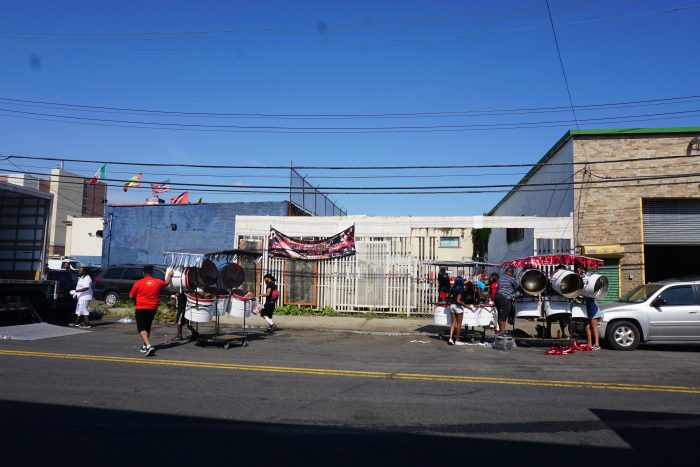
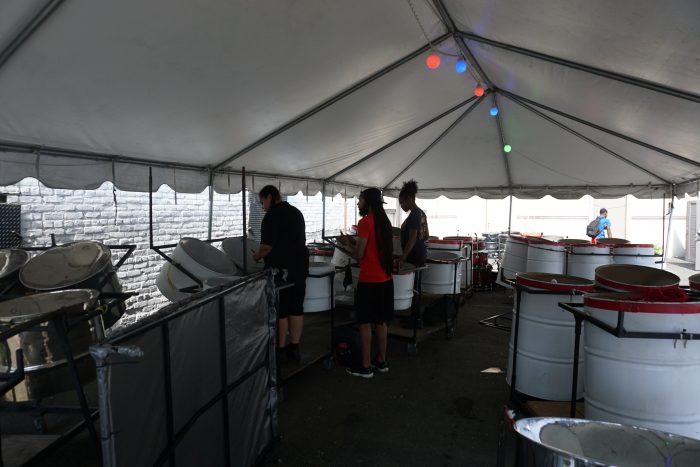
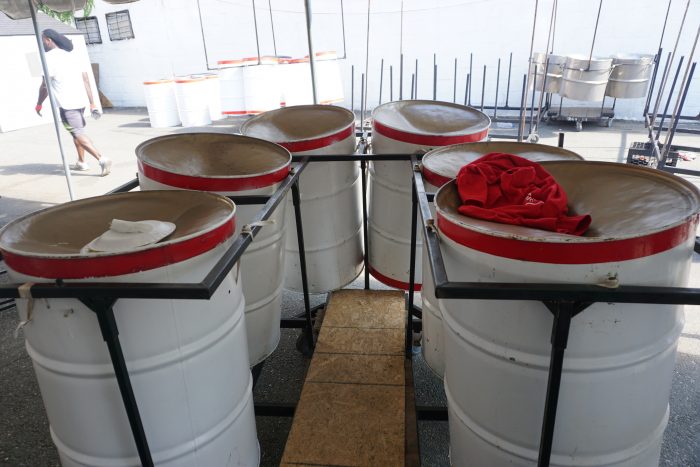
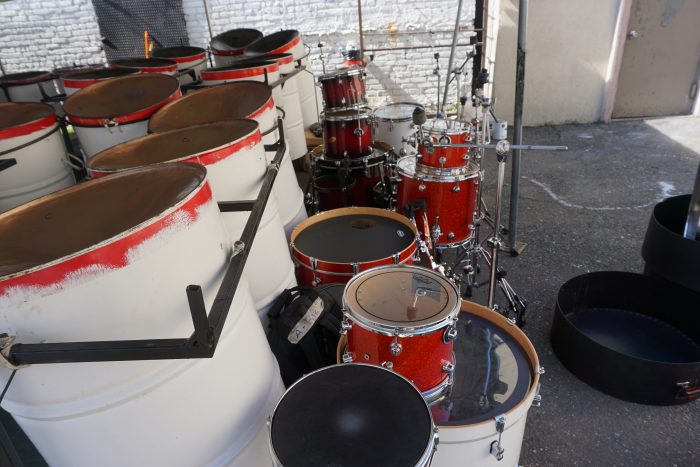
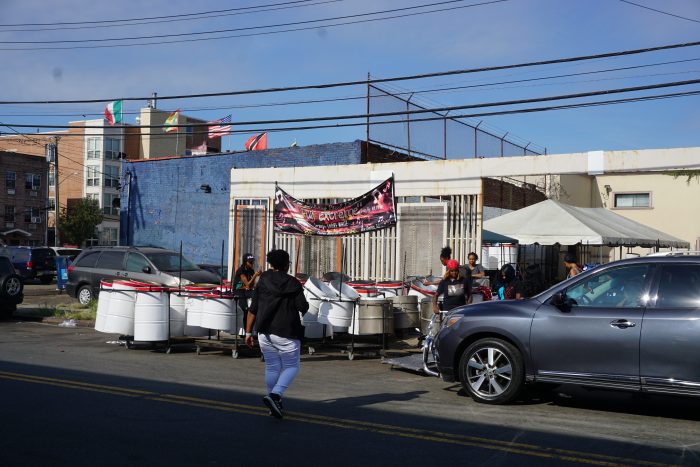
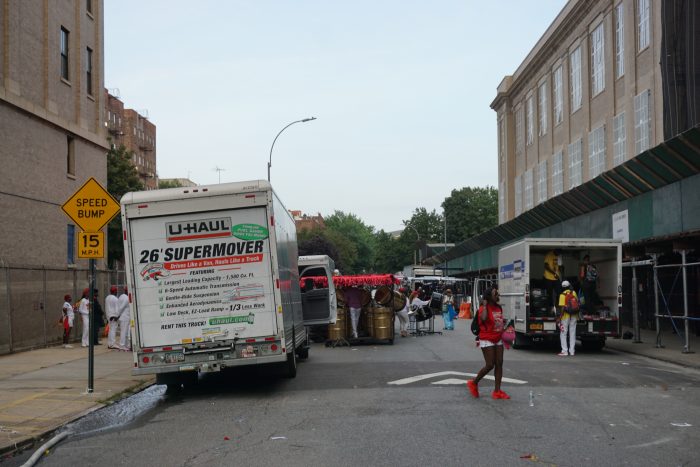
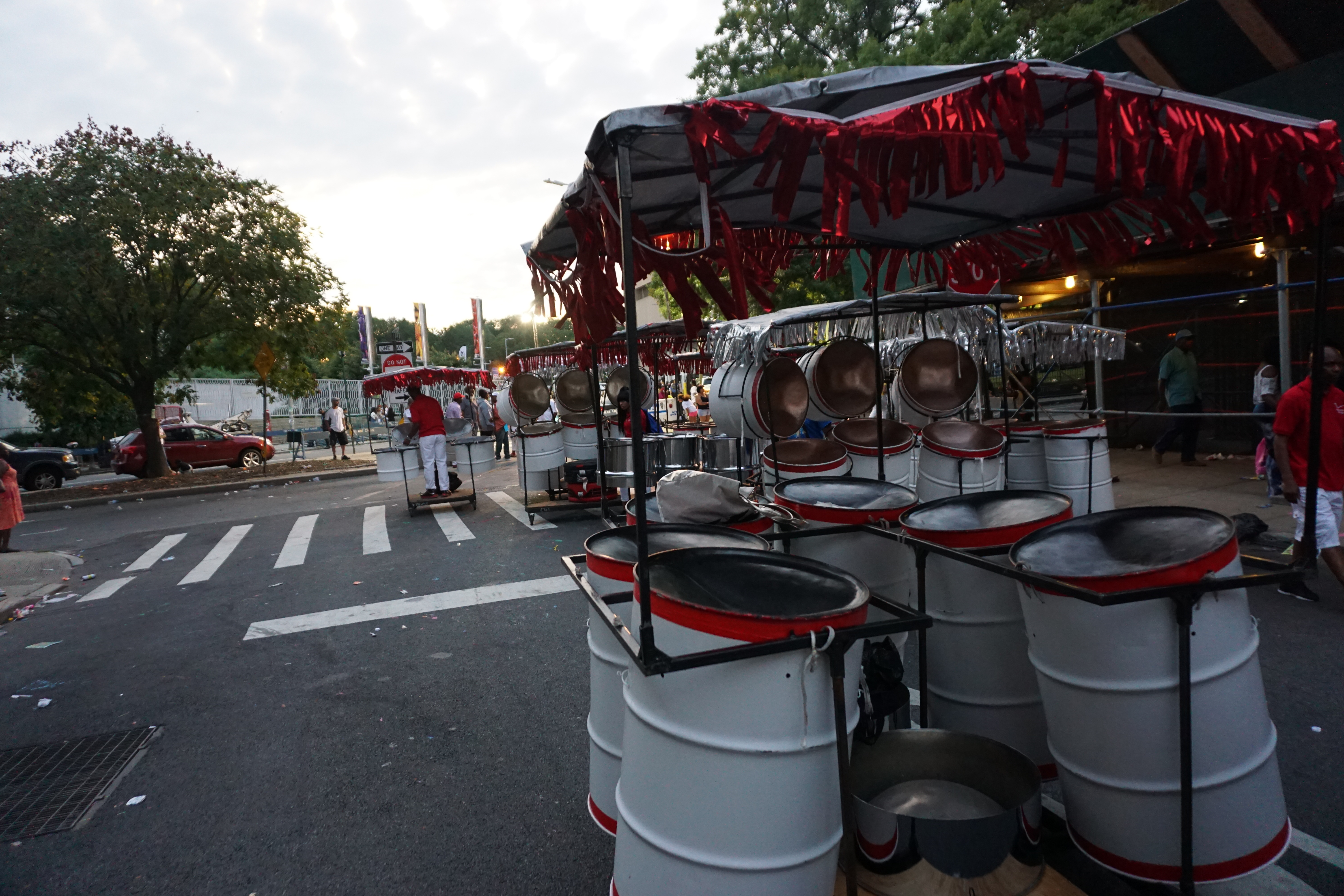
The panyard was tucked away between businesses in an industrial corridor towards the South-Eastern part of Brooklyn. As I arrived the band had already begun the tear-down process with most of their pans and stand already disassembled.

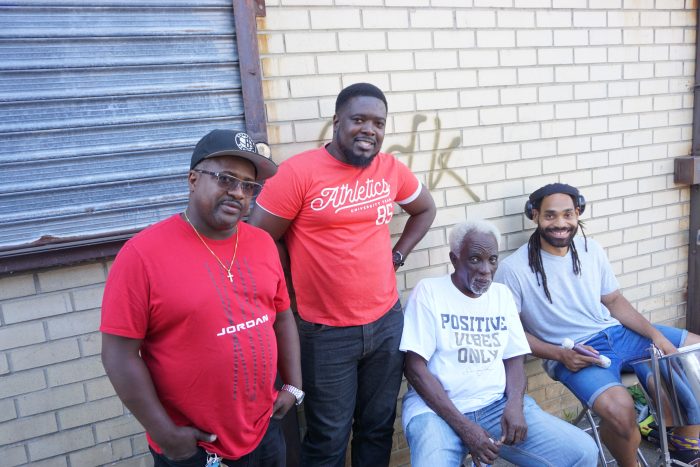
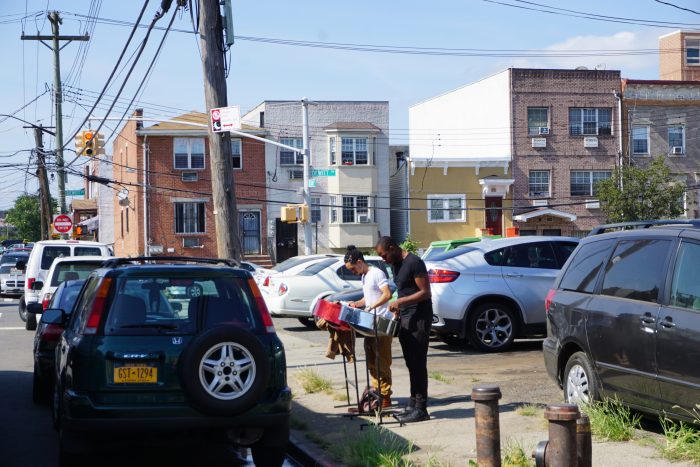
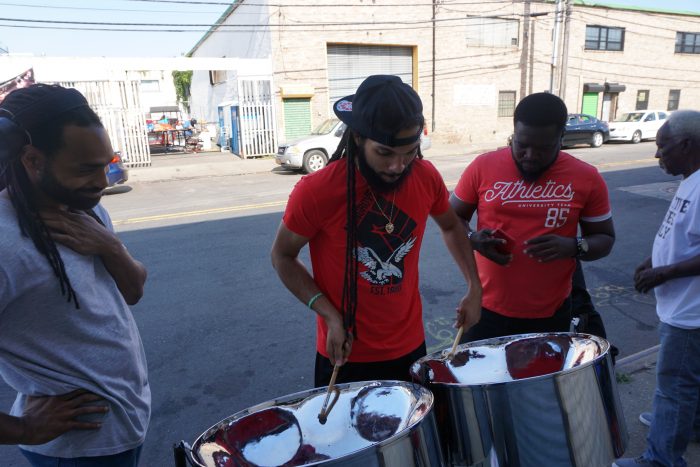
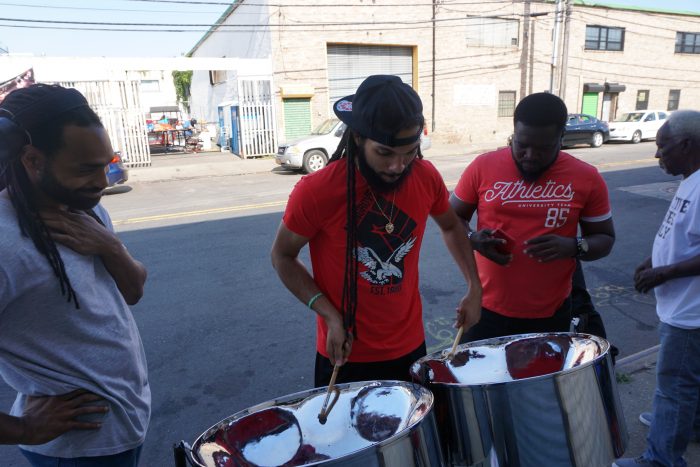
Across the street from the yard was a familiar face: pannist, keyboardist, outspoken pan advocate, tuner and educator Khuent Rose, tuning up a set of double seconds for the band. After saying hi and crossing the street to help the band work a duo of surprise guests joined him. Notable pan builder/tuner August Peters and long-time Trinidadian pan builder/tuner Bertrand Kelman stood beside Rose, looking on as he tuned nervously. “Kelman and Peters stood over while tuning. I was honored and terrified,” Rose later said in a Facebook post.   
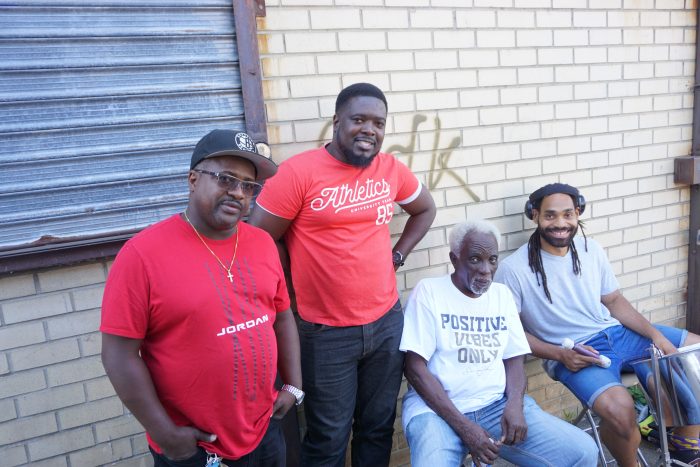
Tuners pose during a street session, including Khuent Rose (right), Bertrand Kelman (right center) and Augustus Peters (left center).

After chatting for a bit, Rose decided to play on the August Peters double seconds set up in front of him. As he expertly played a recognizable piece by Frederic Chopin, I wondered, “Are moments like this what we’re missing on the West Coast?” Soon enough, like a honeycomb attracting bees, a small crowd of pannists stood around, including Andre White, who soon took over on the seconds, dazzling those around him, including me, with a flurry of notes from various calypso tunes.
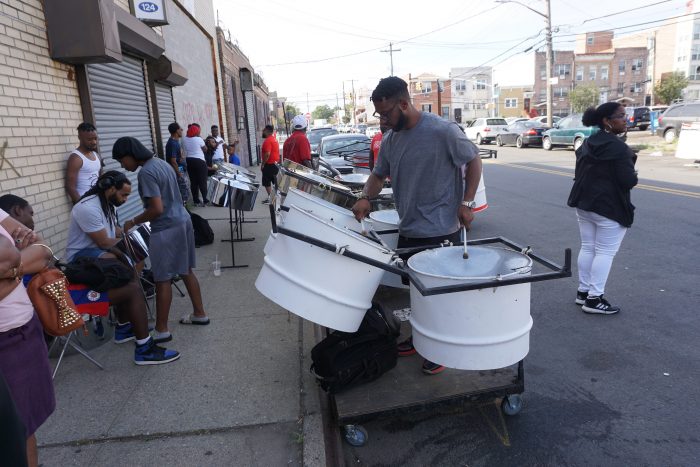
Andre White plays as a crowd looks on.
Obie Quarless practices his part after having only just learned it days before.

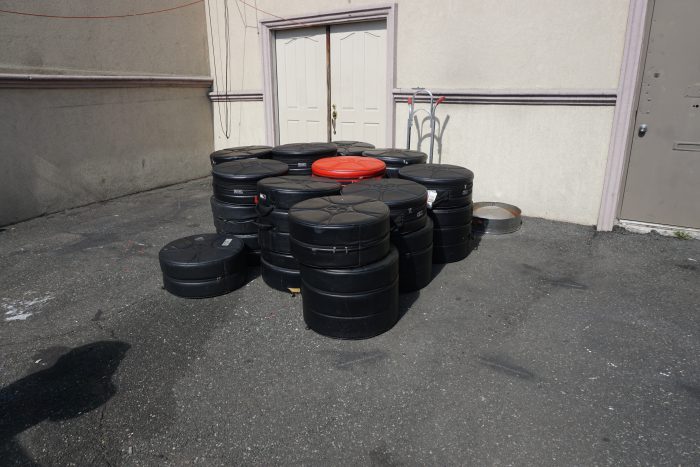
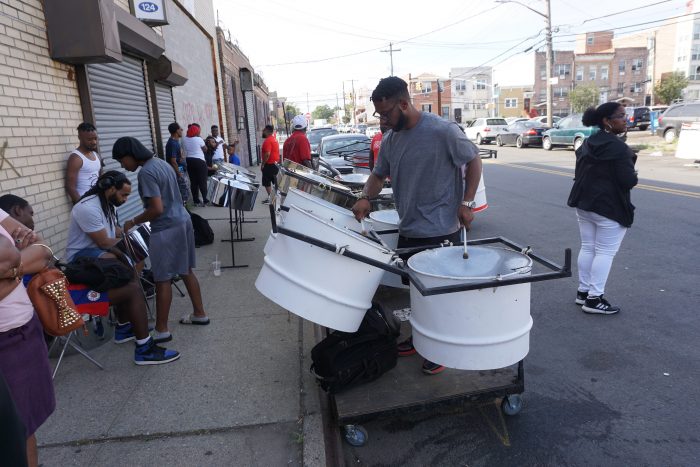
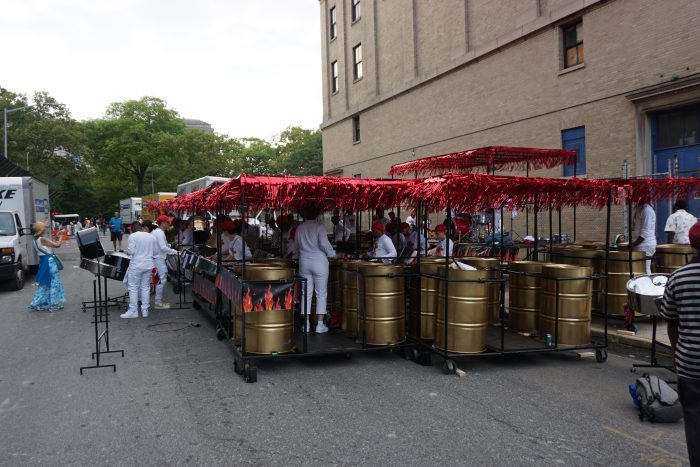
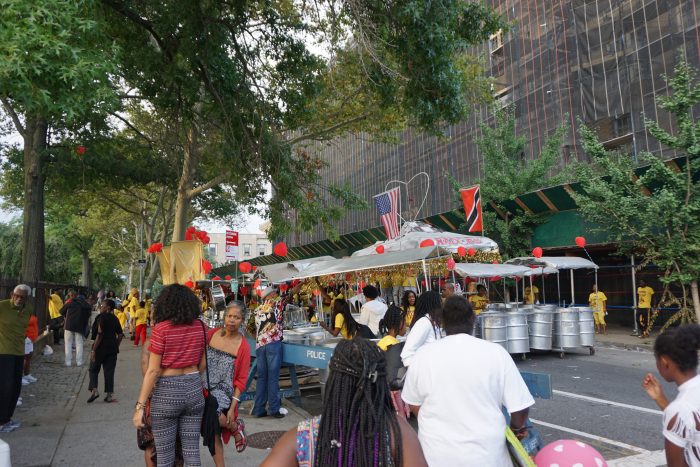
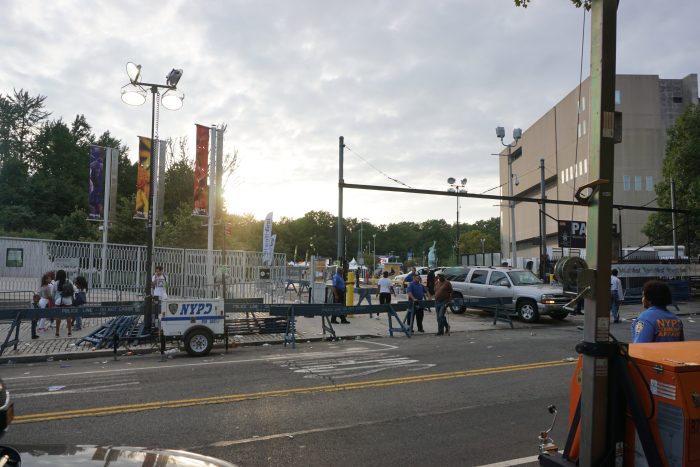
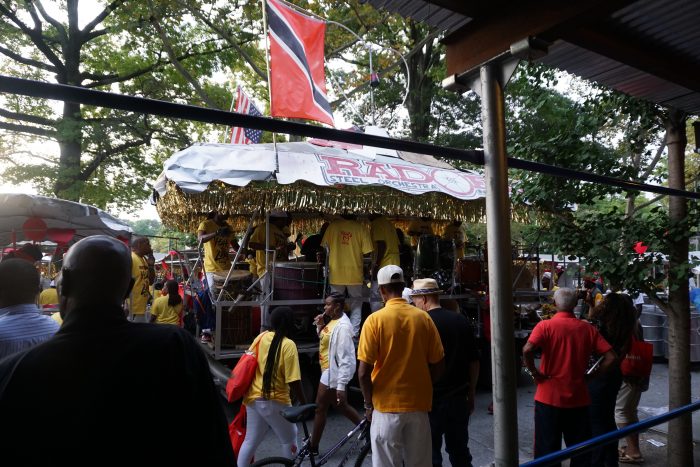
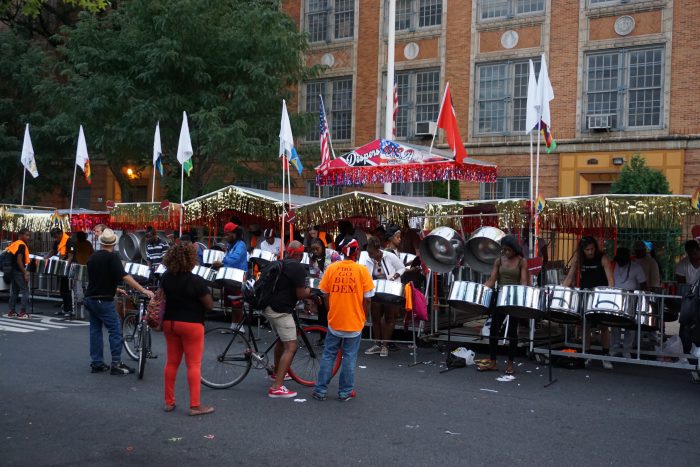
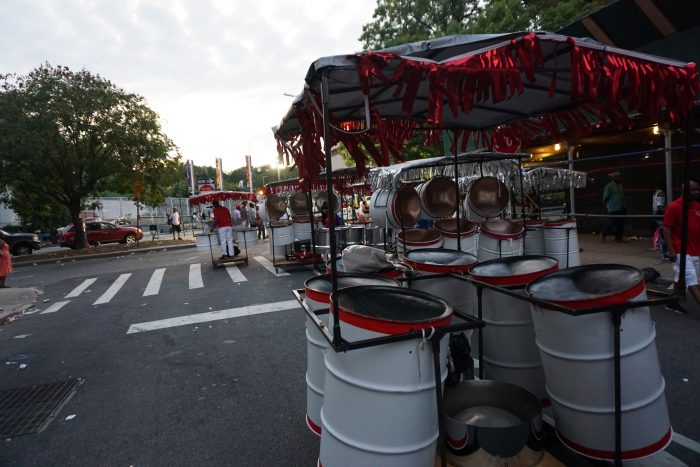
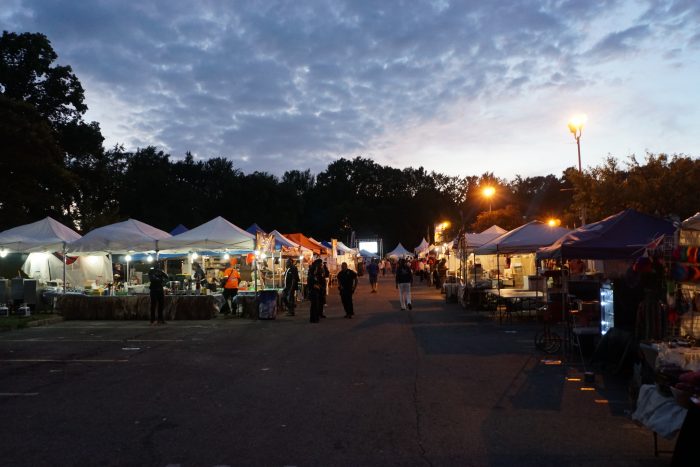
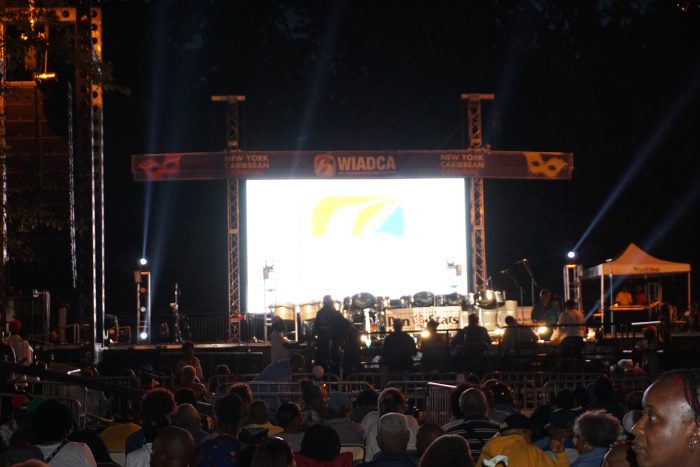
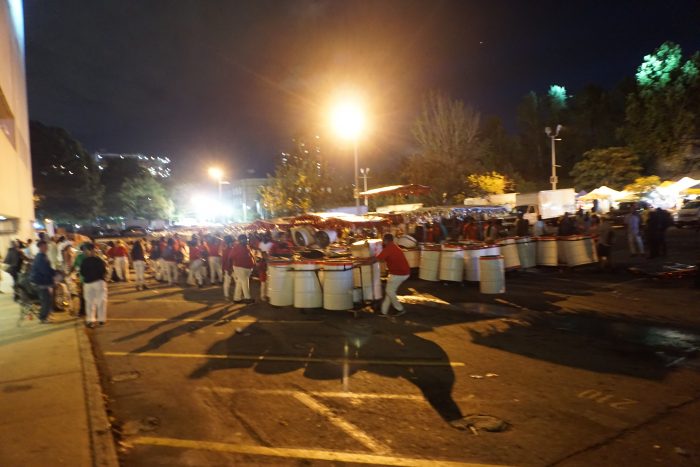
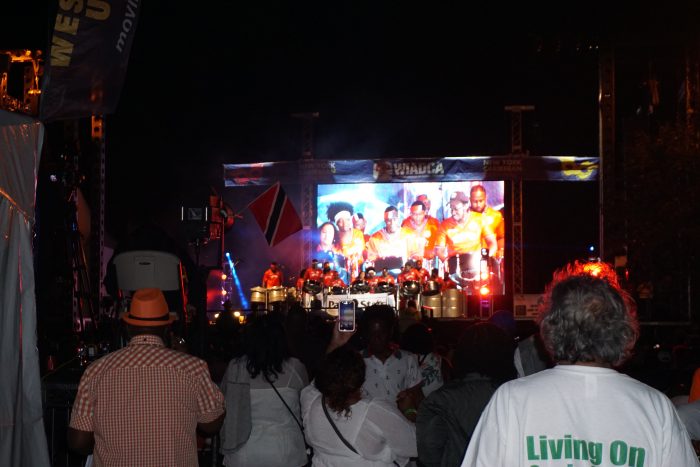
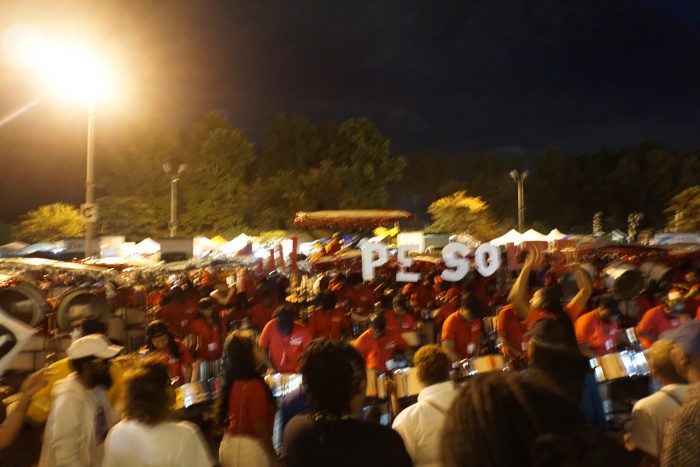
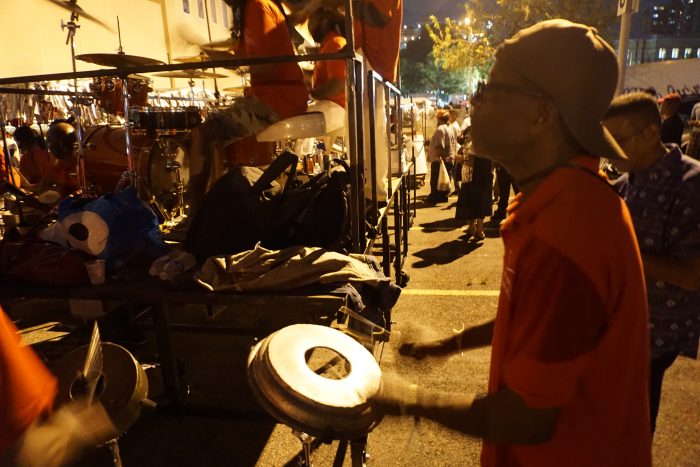
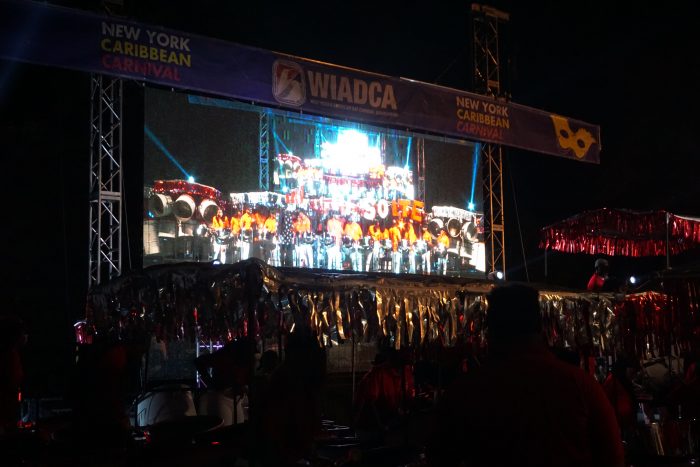
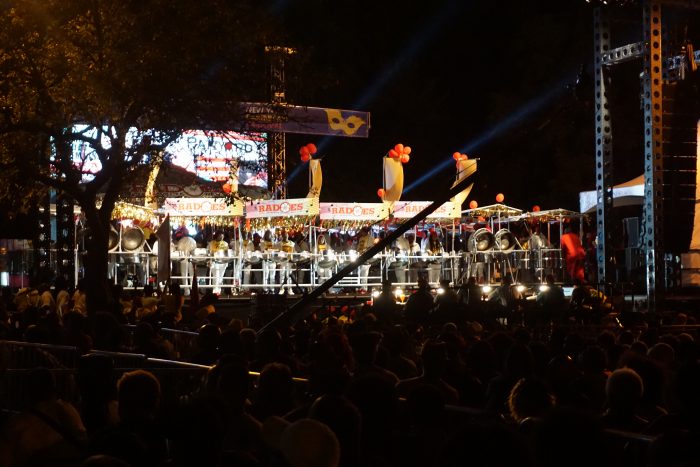
Soon enough, once the jam session had ended, players tore down equipment and began loading into the trucks. I helped move pans around the yard as needed until it was time to roll out. I hitched a ride with one of the players and upon arriving at the Brooklyn Museum grounds I got a glimpse of what the scene would be: hundreds of people filling the streets in different capacities as vendors, fans, band leaders, police and players. The streets all led to a large fairground area where a giant stage resided with a sign that featured the WIADCA logo.  
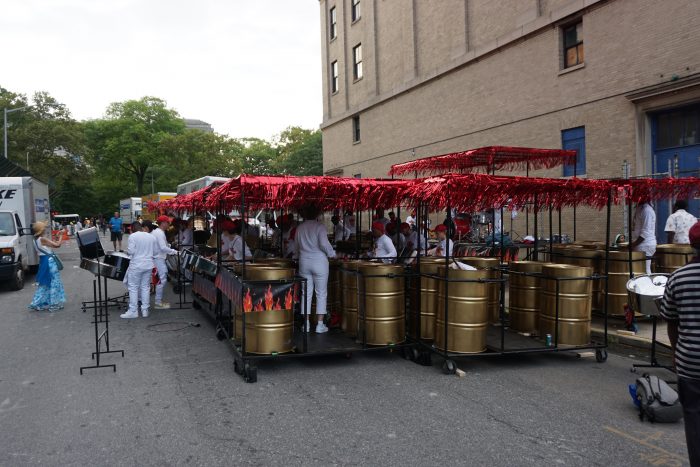
As the band began unloading equipment and other bands began rehearsing on the streets, it became clear that there was one problem: the trucks with the majority of the pans on them had yet to arrive. As time inched closer to the time that the band would need to be set up on the track and rehearsing, I and others became concerned. Then I looked at band leader, Andre White who was as calm as could be. The same could be said of some of the other veterans hanging with the band like drummer and Pan Lara arranger Sheldon Thwaites and Wayne Bernard who were essentially liming and relaxed. Apparently, only the uninitiated who had yet to go to this rodeo need be worried.  
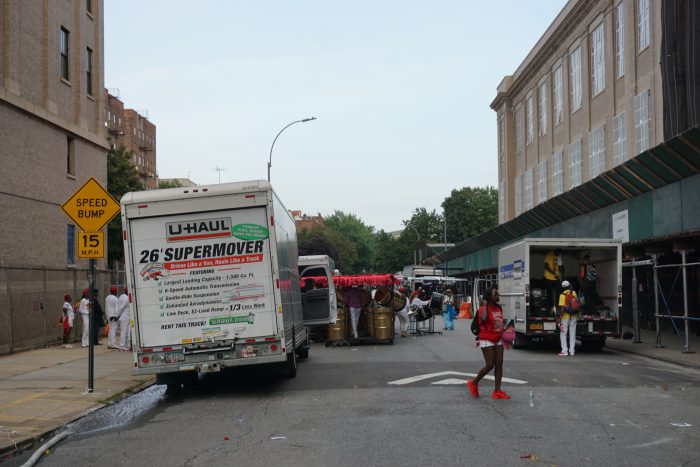
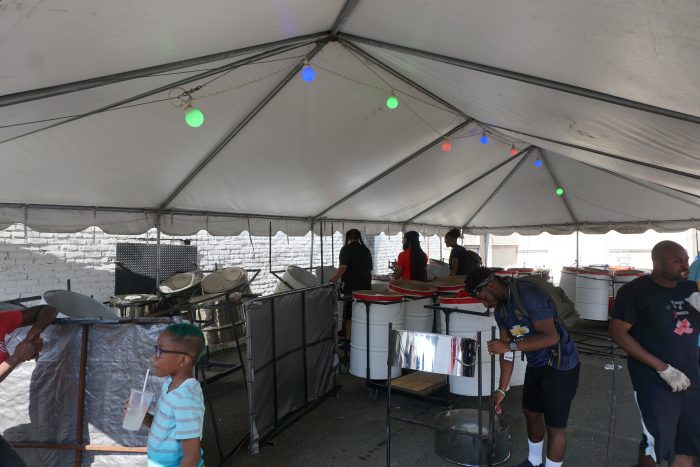
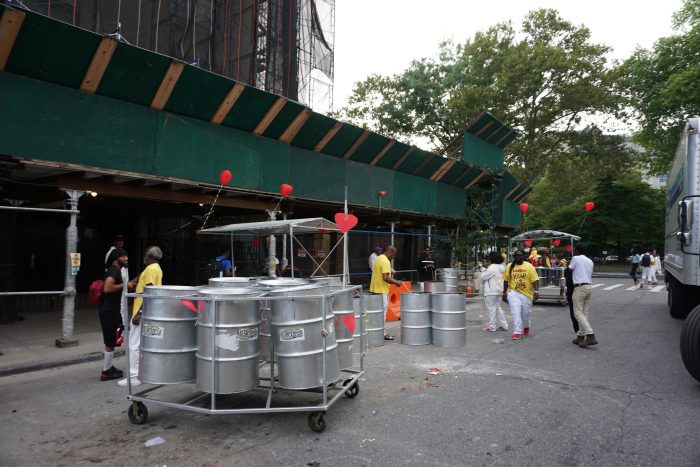
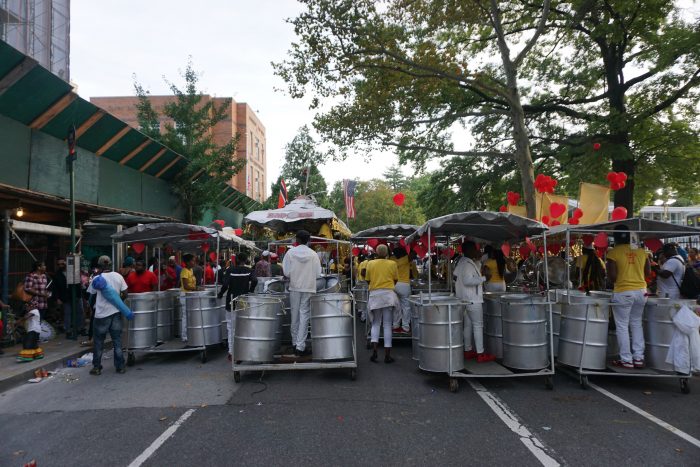
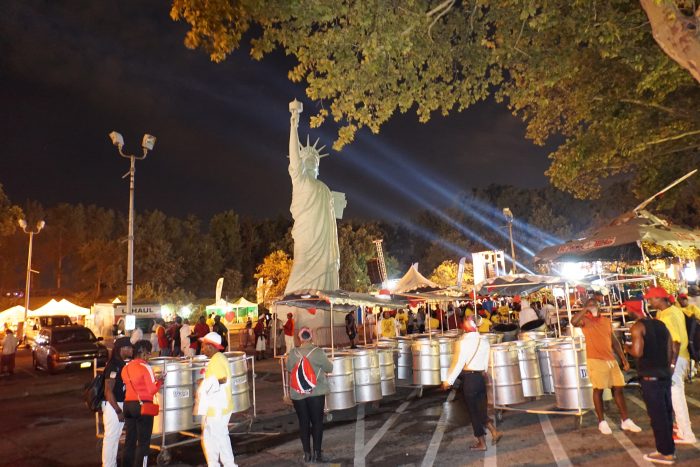
Once darkness fell and more people arrived it became a mess of cars, people and police all converging on the street that separated the neighborhood from the museum grounds. The PESO players and supporters all hurried carts of pans across the busy intersection, stopped briefly by the event staff to check bags as needed. Once we were inside, we found a corner to park the equipment and wait. And wait we did. Up until the last possible minute when the trucks finally arrived enough time for the band to set up and rehearse their piece about two times before being summoned on stage in front of the massive festival crowd, which by that point was likely over a thousand people.

Performance and Aftermath
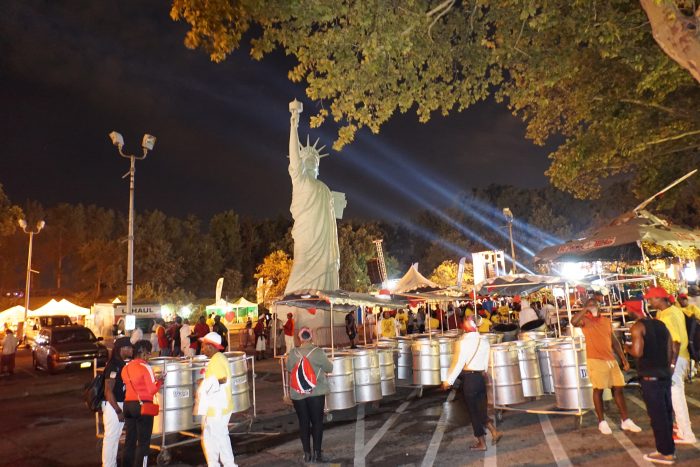
Since I wasn’t playing in the band that night, I walked around the grounds during their time on the track and ran into a familar face: Hueloy Yip Young, otherwise known to the global pan community as Uncle Hueloy, a long-time steelpan advocate known for having played and supported pan since being a founding member of the Harmonites Steel Orchestra in Trinidad. As I approached him, never having met him in the flesh and only knowing him from social media, I introduced myself and he immediately took me under his wing, introducing me to other pan notables in the scene and buying me beer – repeatedly. It was here that I met another amazing pan person who I instantly liked, Kristin Murrell. She introduced me to several notables in the community, including Martin Douglas, president of the USSA (United States Steelband Association).
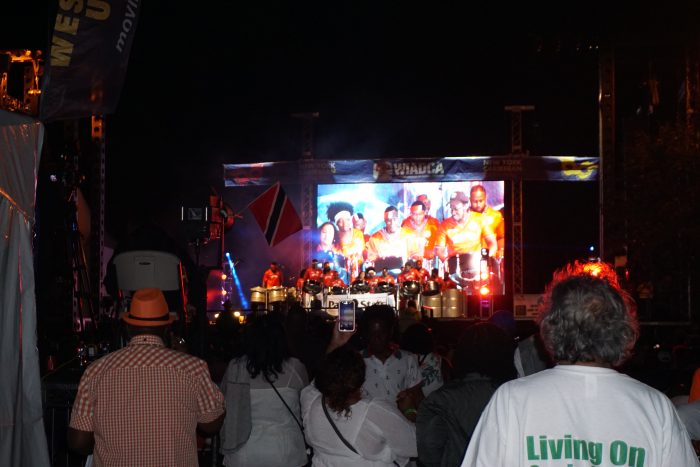
As each band performed there was a noticeable feeling towards those who had the best performance. In Trinidad, Panorama performances range from being all about the popularity of the song being played to political motivations and sometimes more about the arrangement itself. This year seemed to be a combination of all three for both the performers and audience.

“I felt good going into this year’s Panorama despite all of the confusion from the year before. It was a lot of work putting the band together at the last minute like we did, which was mostly due to not really being sure if there was going to be a panorama to begin with,” PESO arranger Andre White said. “I was quite pleased with our performance despite all of the confusion on the day. Never got to rehearse properly before we went on stage so there was a bit of unsettling feeling among the players, but we did well. And for a band that’s only been in existence for three years we have managed to remain in the top three and in the discussion to take it. Only upwards for PESO.”
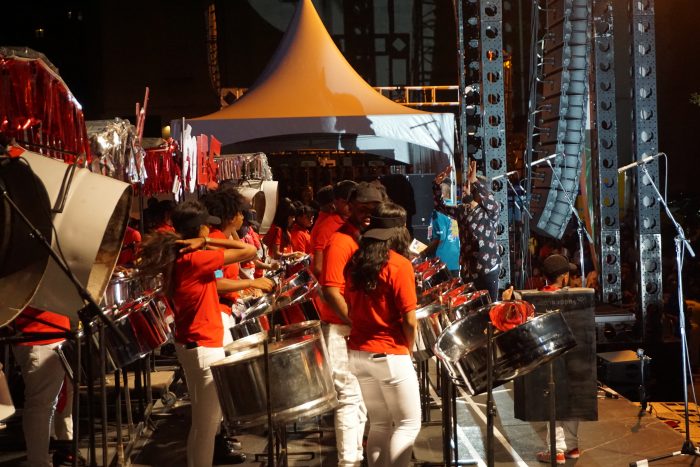
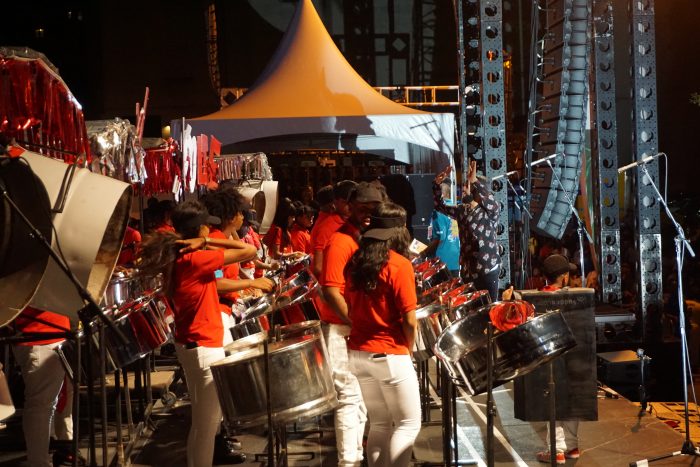
Andre White leads PESO in their performance.

Aside from placing third out of seven bands, behind CASYM and first place winners Despers USA, PESO achieved notoriety across the pond by attracting players from London to play with the band, largely thanks to their dedication to White after Mangrove Steel Orchestra won that event in 2018 with his arrangement of “Hulk”. Members of both Mangrove and Ebony steel orchestras came out to play with PESO.

“I have been fortunate for the past couple of years to usually have a contingency of players come across from the UK to play with the different bands and this year was no different. We had eight players from Endurance and Mangrove that came to give us that strength we needed and it’s appreciated so much,” White said. “My goal with this years arrangement of ‘Hello’ was the same as all of my arrangements and that is to tell a story. This one was actually very different in terms how I constructed the arrangement. The melody in the song was so strong, I just let the song carry itself. The people loved it.”

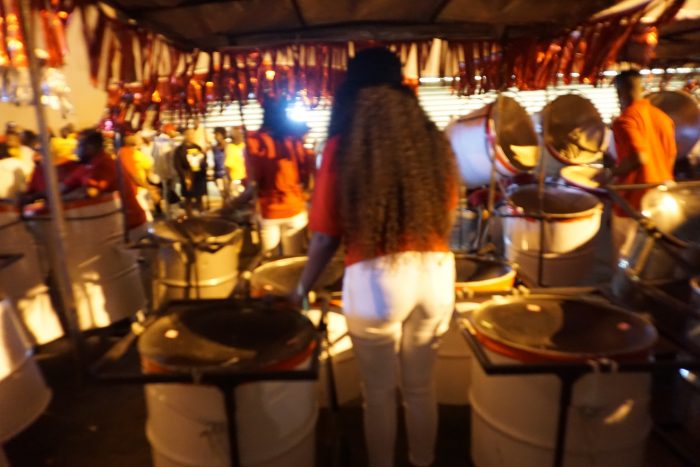
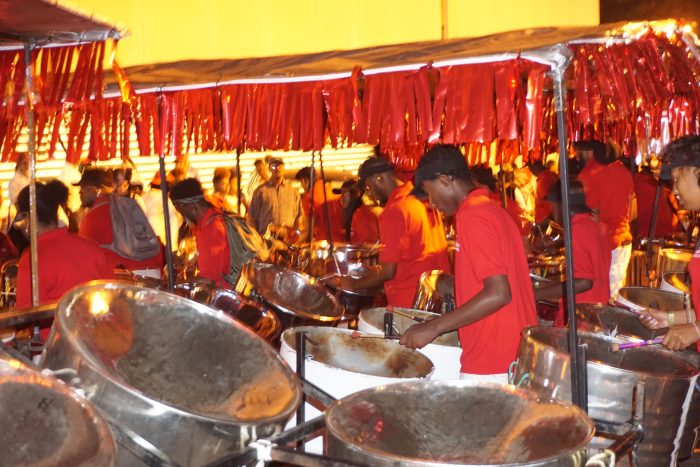
Being on stage during PESO’s performance I can honestly say it was an epic experience. If watching from the crowd’s perspective is a thrill, imagine getting a first hand look at the band from behind and the side. We’re talking 80 players, including engine room. Similar to Trinidad Panorama, you could likely hear the music from several miles away.

After the bands finished and the judges tallied, you could feel the electricity from the partying festival crowd, drunk on music and booze. Suffice to say, no one was sitting down when the winners were announced.
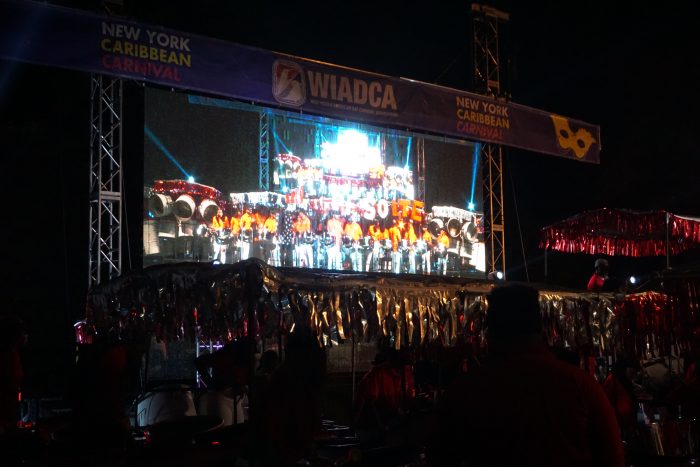
“I felt the band’s performance was a good one, especially seeing how short the season was and having an extremely late start compared to the two previous years,” Bernard said. “Of course the overall goal is to win Panorama but the effort of pulling together and placing in the top three this year I am proud of the players and management team of PESO.”

Future Plans

With a successful NY Panorama now behind them, there was a sense that the future might be looking up for the NY pan scene.

“I hope pan on the whole gets the business aspect together. We need the correct leadership in the governing bodies to push steel and to the levels and platforms in which it deserves to be,” White said.

Bernard echoed that sentiment regarding leadership in the pan community. “In order to improve  every year everything revolves around being organized and focused on the task at hand. At the end of the day it really does not matter how good your band, players, song, or instruments are. You have to have a good game plan in place and a fully committed team ready to execute it,” he said. “I feel the status of pan is in a very good place with young talented folks worldwide pushing the envelope to find new innovative ways to push the instrument always. I would like to see it on the mainstream level as other instruments out there. I find right now if many people hear it play they can easily relate and recognize the sound but I would really love to see it more main stream of course such as the Grammy awards or starring in a popular music video for example.”

Considering the struggle the instrument has faced from within in recent years, not just in New York but globally, seeing each region get its affairs in order locally may just be the starting point for global change. Once that’s done, the sky’s the limit. But for now, going out to see a local pan player, band or even a large event like NY Panorama is a good start.   

Pan Evolution Steel Orchestra “Hello” (NY Panorama 2018)
Pan Evolution performs “Hello” at NY Panorama.
WA Production for music producers

Trinidadian Slang 101: How to Talk Like a Trini

Couple talking on street

To the uninitiated, the language of Trinidad and Tobago—Trini English Creole—can sound like a vibrant, rhythmic puzzle. It’s more than just an accent; it’s a culture woven into every word. For sketch comedian Megan Jeffrey, whose immersion came through family and a love of global culture, the fascination of the Trini language was centered around both culture and humor.

Comedian Megan Jeffrey.

“I love languages and doing impressions of people, most notably Trini impressions, and have an insatiable curiosity about the world,” Jeffrey said. “My experience with Trinidadian culture started very early. I grew up in a Baha’i family, which espouses unity in diversity, so attending any Baha’i gatherings was like going to a mini UN General Assembly. Then in middle school I had a Trinidadian teacher who took me under her wing and inspired me to be myself. But my biggest exposure came through a 15-year marriage to a Trinidadian. I came into their family when I was 17, so Trini culture became home to me in many ways. From the music to the humor style, it all feels like family.”

As someone who loves and is immersed in Trini slang and its many nuances, Jeffrey highlighted some key words, phrases and inflections to be aware of if you’re planning on visiting Trinidad or hanging with Trini people in the near future.

Essential Phrases for the Trini Newcomer

One of the most defining traits of Trini slang is its use of tone and repetition. The phrase “eh heh” is a perfect example. As Jeffrey observes, its meaning is differentiated only by tone. Depending on the inflection, it can signify agreement, surprise, acknowledgment, or even skepticism. Another instant marker of a true Trini is the emphasis achieved by repeating a word: “That thing heavy heavy!”

For those looking to socialize, here are some crucial words and phrases:

– Liming: This simply means “Hanging out. Pure and simple. If yuh limin’, yuh coolin’.” It describes the casual, relaxed social gathering so central to island life.

– Bacchanal: This versatile word can refer to anything from a scandal or chaotic drama to the exciting, unrestrained fun of Carnival. As Jeffrey notes, “Carnival is pure bacchanal!”

– Dat Ting SWEEET!: Used to describe both a sensation and a feeling of pure enjoyment.

– Miss Lady/Mr. Man: A playful way to describe someone.

– “Like he dotish or…”: Used to describe someone, in disbelief, as acting foolish or silly.

Common Expressions

Trini slang also has specific, expressive words for common human experiences, including:

TermMeaningContext
TabancaEmotional heartbreak or deep longing after a breakup.“Oh gosh, yuh missin she?! Like ya have tabanca in truth! Doh worry nah, another gyal gon an come.”
MacoNosy; someone who peers into other people’s business.Usually playful, but the act itself is considered intrusive: “Macos are EVERYWHERE.”
CommessConfusion, drama, or excessive gossip.“If someone likes too much ah commess, it means they like drama.”
DotishFoolish or silly.Used in scolding or disbelief: “Like he dotish or…”

Words to Know (And Maybe Avoid)

Understanding certain terms is vital for navigating social waters. One of the most important cultural lessons is understanding the fluidity of time. As Jeffrey explains, the phrase “ah comin jus now” truly “means absolutely nothing! A Trini will come when they come.”

For tourists, Jeffrey advises caution with specific phrases that relate to dancing and location, as they can be easily misunderstood:

– Avoid asking to “Take me to Laventille,” a historically tense area.

– Be clear about the difference between wine (the beverage) and “wine,” “jook,” or “jam,” which refer to close, rhythmic dancing.

Jeffrey also explains the famous Carnival phrase, “Yuh cyah play mas if yuh fraid powder.” It means you shouldn’t join the fun if you’re afraid of the mess—or, more broadly, “don’t go to carnival/jouvert” if you’re worried about getting dirty. It’s a metaphor for committing fully to any endeavor.se, “Yuh cyah play mas if yuh fraid powder.” It means you shouldn’t join the fun if you’re afraid of the mess—or, more broadly, “don’t go to carnival/jouvert” if you’re worried about getting dirty. It’s a metaphor for committing fully to any endeavor.

WA Production for music producers

Sounds of Rebellion: How Steelpan Defied Authority

The Brute Force Steel Band from Antigua in the West Indies, circa 1965.
The Brute Force Steel Band from Antigua in the West Indies, circa 1965. (Photo by Archive Photos/Getty Images)

Discover how steelpan beat colonialism as a symbol of freedom.

Born from the resourcefulness of marginalized communities in Trinidad and Tobago during the 1930s, the steelpan was crafted from discarded oil drums and biscuit tins. It stands as the only acoustic instrument invented in the 20th century, emerging as a tool of cultural expression against colonial oppression and restrictions on traditional drumming. Once dismissed as crude by authorities, the steelpan evolved into a symbol of defiance, resilience, and artistry for those who turned adversity into innovation.

The Historical Roots of Musical Rebellion

From 1526 to 1867, over 10 million Africans were enslaved across the Americas, including Trinidad, where British colonial rule perpetuated slavery to sustain sugar plantations. Enslaved Africans resisted subjugation in various forms, including preserving cultural and spiritual practices. Freed African-American soldiers known as the Merikins, who had fought for Britain in the War of 1812, settled in southern Trinidad. They introduced a syncretic religion blending Yoruba and Protestant Baptist traditions, embodying resistance and resilience.


A rhythmic tradition called Tamboo Bamboo emerged in the late 1800s as part of the cultural fight for freedom. Bamboo instruments like the bass, foule, and cutter were used to create melodic percussion, accompanied by songs in Creole and African languages known as lavways. This practice laid a foundation for the steelpan’s rhythmic identity while preserving ancestral heritage.

Gangs and Stereotypes

During its formative years, the steelpan was stigmatized due to its association with street gangs. Rival steelbands clashed over territorial disputes, fueling negative stereotypes about the instrument and its players. Despite this, the steelpan became a creative outlet for marginalized youth, offering a sense of identity and expression in a world that sought to silence them. 

Eventually, local police intervened and forced rival gangs to stop fighting and strike a truce. The gangs proposed they continue their rivalry in a healthy way by engaging in musical warfare with steelpan competitions. This led to various competitions over the years, from the Mas Band bomb tunes to Panorama, Pan is Beautiful and other events. 

Innovators such as Ellie Mannette, Ray Holman, Len “Boogsie” Sharpe and Beverly Griffith elevated the instrument, transforming it into a symbol of peace and artistry.

Panorama and Unity

The introduction of Panorama in 1963 marked a new chapter for the steelpan. This annual competition allowed rival bands to compete in a friendly way while establishing a deeper foothold in both T&T and Caribbean culture. This event led to the creation of other similar events throughout the Caribbean and abroad in places like the United States, the United Kingdom, France and Japan. 

Steelbands showcased their talents and collaborated, replacing violence with pride and community spirit. Panorama elevated the steelpan’s cultural status, demonstrating its ability to inspire creative excellence and mutual respect.

Steelpan’s Influence in Global Music

The steelpan has transcended its Caribbean origins, making its mark on global music. Featured in genres such as reggae, hip hop, rock, Soca, and even country music, the instrument’s distinctive sound has captivated audiences worldwide. Artists like The Beatles, Jimmy Buffett, David Rudder, and Kodak Black have incorporated steelpan into their music, showcasing its versatility and bridging cultural divides.

In addition to mainstream music, contemporary steelpan performers such as Victor Provost, Jonathan Scales, and Joy Lapps-Lewis have highlighted the instrument’s technical and artistic potential. Steelpan festivals, including competitive events in London, Miami, and Toronto, as well as workshops in countries like the United States, Japan and Sweden, celebrate its growing global presence.

Modern Recognition and Social Impact

Today, the steelpan is celebrated as a cultural icon and a unifying force. Beyond its musical contributions, projects like Peace Drums for Israel demonstrate its power to bring together communities divided by conflict. This initiative uses steelpan music to foster dialogue between Israeli and Palestinian youth, underscoring its ability to promote harmony even in challenging circumstances.

At its core, the steelpan represents resistance against oppression. Its journey—from a discarded oil drum to a global icon—embodies the power of marginalized communities to reclaim their voices and assert their identity. Whether at Panorama, in popular music, or in peace-building projects, the steelpan continues to inspire unity and creativity. Its timeless melodies remind us that beauty and strength can emerge even in the face of adversity, making it a beacon of hope and transformation.

Learn more about steelpan history HERE.

National Symbols of T&T - The Steelpan
WA Production for music producers

The Evolution of the Handpan

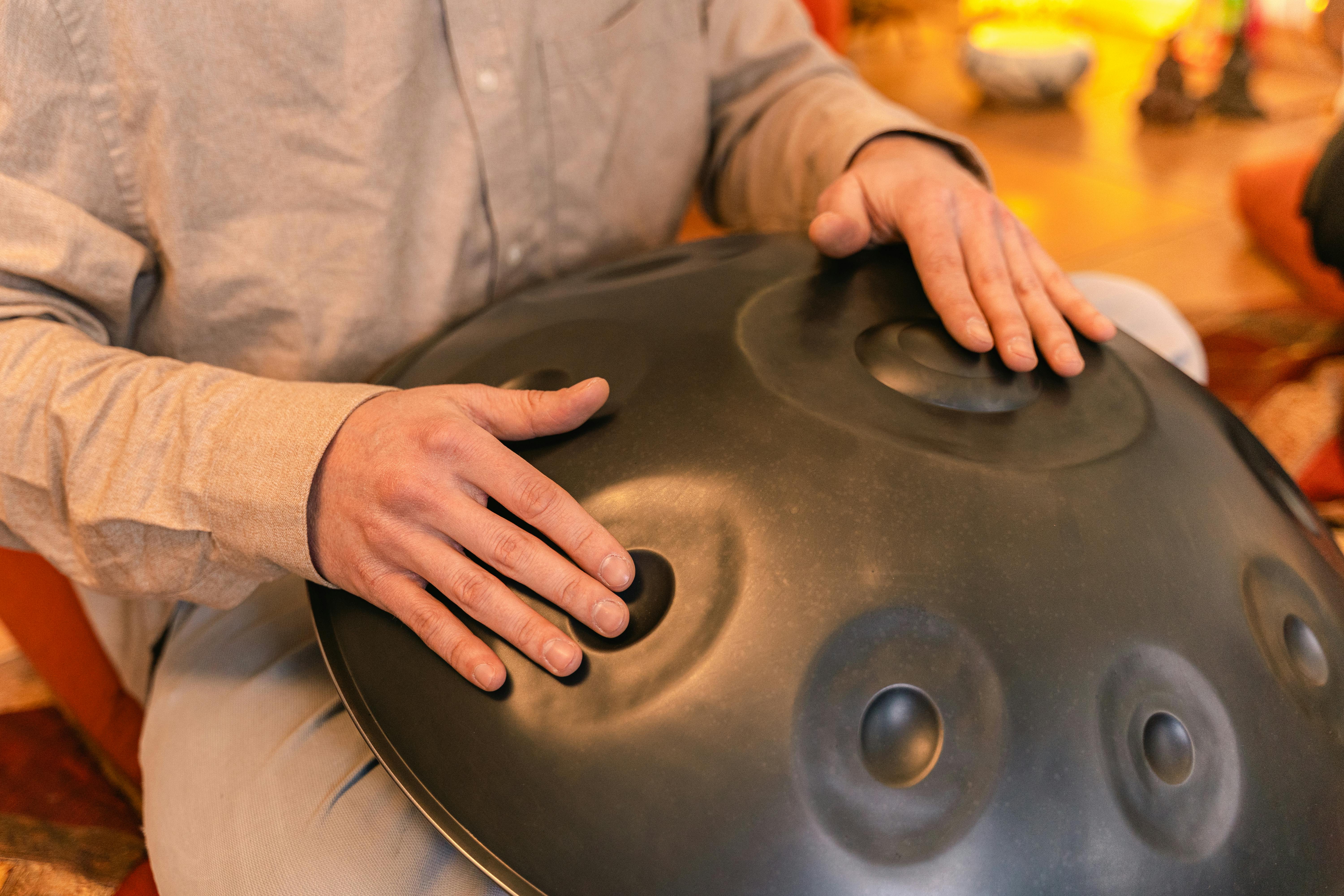
Hands playing a hand pan.

Discover the origin of the handpan and how it’s used today.

There are many instruments in the steelpan family that were invented with the intent that they be played in a band or orchestra, and with mallets. But in the case of the handpan, tradition was turned on its head to unveil an instrument that wasn’t as much related to but rather inspired by steelpan. 

As a relatively recent addition to the world of acoustic instruments, the handpan has captivated musicians and listeners alike with its ethereal tones and unique design. Its history consists of invention, innovation, and global adoption.

Origins and Creation

The first version of the handpan was invented in Switzerland in 2000 by Felix Rohner and Sabina Schärer, founders of PANArt. They invented the instrument known as the “Hang.” The Hang (pronounced ‘hung’), derived from the Swiss-German word for “hand,” was inspired by various percussion instruments, including the Trinidadian steelpan, the Indian ghatam, and the Indonesian gamelan.

Rohner and Schärer meticulously crafted the first Hang from two half-shells of nitrided steel, painstakingly hammering and tuning the surfaces to create a central note and a series of surrounding harmonics. The resulting instrument produced mesmerizing, resonant sounds that quickly garnered attention.

Chief Builders Today

Since the invention of the Hang, numerous makers have emerged, each bringing their own innovations to the handpan craft. Among notable builders is David Beery, known for his high-quality instruments under the brand Dave’s Island Instruments. Beery’s handpans are celebrated for their tonal precision and craftsmanship.

Other prominent builders include Ayasa Instruments in Russia, PanSnap in the United States, and Echo Sound Sculpture in Germany. Each builder has contributed to the evolution of the handpan, experimenting with different materials, shapes, and tuning techniques to enhance the instrument’s versatility.

Festivals and Events

The handpan community thrives on collaboration and shared experiences. Festivals and events dedicated to the instrument have sprung up worldwide, offering players and enthusiasts a platform to connect and celebrate their passion. Notable events include:

  1. HangOut UK: One of the first handpan festivals, held annually in the United Kingdom, attracting musicians from around the globe.
  1. Pantasia Festival: Hosted in the United States, Pantasia features workshops, performances, and communal jam sessions.
  1. Handpan Festival France: A prominent European festival that showcases diverse handpan talents and fosters cultural exchange.

How It’s Made

The creation of a handpan is a labor-intensive process that requires exceptional skill and precision. The journey begins with two sheets of high-quality steel, which are shaped into half-shells. These shells are then carefully hammered and tuned to produce distinct notes and harmonics.

The tuning process is intricate and involves adjusting the tension and thickness of the steel to achieve the desired sound. Some modern builders incorporate advanced technologies, such as CNC machines and laser cutters, to enhance the accuracy of their instruments. The final product is a work of art, combining traditional craftsmanship with modern innovation.

Notable Performers

The handpan has inspired a new generation of musicians who have pushed the boundaries of its musical potential. Daniel Waples, a British handpan artist, is known for his virtuosic performances and collaborations with musicians from various genres. Manu Delago, an Austrian percussionist, has brought the handpan into the spotlight through his work with artists like Björk and Anoushka Shankar.

Other notable performers include Kabeção, a Portuguese musician renowned for his improvisational style, and Yuki Koshimoto, a Japanese handpan player who has captivated audiences with her emotive compositions.

Use in Popular Music, Meditation, and Yoga

The handpan’s enchanting sound has found its way into popular music, meditation, and yoga practices. Its soothing tones create a tranquil atmosphere, making it a favored instrument for relaxation and mindfulness.

In the realm of popular music, the handpan has been featured in various genres, from ambient and electronic to world music and jazz. Artists like Hang Massive and Portico Quartet have incorporated the handpan into their music, blending its unique sound with contemporary styles.

In meditation and yoga classes, the handpan’s resonant frequencies help practitioners achieve a state of calm and focus. The instrument’s ability to produce harmonic overtones creates a sense of deep relaxation, making it an ideal companion for mindfulness practices.

The handpan has proven itself to be a permanent mainstay in the arsenal of world percussion.  From its origins in Switzerland to its global presence today, the instrument continues to inspire and connect people across cultures. Whether in the hands of a seasoned performer or a meditation practitioner, the handpan’s captivating sound serves as a bridge between tradition and modernity.

Dii: How to Shape Handpan Notes
WA Production for music producers

Basics of Steelpan: History of the Steelpan Instrument

An early steelpan performing with the Basics of Steelpan logo in the corner.

The steel pan, also known as the steel drum, comes from Trinidad and Tobago (T&T) in the Southern Caribbean. Made from 55-gallon steel barrels and played with rubber-tipped mallets, the steelpan is the only acoustic instrument invented in the 20th century. It’s a huge part of Caribbean music and has gained popularity worldwide, including in the U.S., UK, Denmark, Finland, and Japan.

Origins and Evolution

Steelpan was invented on the island of Trinidad in the early 20th century. Back then, Trinidad was a British colony with a mix of African, Indian, and European cultures, and the music scene was dominated by calypso music—a fusion of African and European styles.

The steelpan’s invention began during slavery. In the 1800s, enslaved people made drums for singing and dancing during early Carnival celebrations. In Trinidad, as well as the U.S., the enslaved would use drums as a way to send coded messages to each other. Drummers discovered that they could replicate tones of speech by striking and holding the drum in certain ways. This practice was eventually discovered by colonial masters and suppressed. After being freed in 1834 in Trinidad & Tobago, this coded drum practice rose again, but colonialists worried it could lead to social unity and revolt, so they banned it legally. These now free people turned to bamboo for music, creating Tamboo Bamboo bands, and later incorporated biscuit tins as percussion instruments.

Around 1938, these biscuit tins evolved into the first steelpan instruments. Young musicians found that striking the tins with sticks created notes. Early steelpans were convex, but they soon discovered that more notes could be added by making them concave. These early steelpans had a limited musical range and were played with sticks and bare hands.

Pioneers like Winston “Spree” Simon, Neville Jules, and Ellie Mannette transformed the instrument into the sophisticated steelpan we know today. Today’s pans use 55-gallon oil barrels and include a full orchestra of soprano, alto, tenor, and bass pans. Mannette, known as the “father of modern steel pan,” and “the Stradivarius of the steelpan” played a crucial role in its development.

From Fists to Scorecards

During World War II, steelpan spread to other Caribbean islands and eventually the world. In the 1950s, steelpan makers in Trinidad formed steel pan orchestras, playing in more structured musical settings. Early steelbands were seen as a threat due to their violent, gang-like nature, leading to police intervention and the creation of the first Panorama competition, where bands competed with music instead of fists.

Steelbands gained popularity globally, even being adopted by the military in some places. The U.S. Navy Steel Band, formed in 1957 with Mannette’s help, was stationed in Puerto Rico until it disbanded in 1999. In the 1960s and 1970s, the steelpan became integral to the Caribbean music scene, replacing calypso with Soca music. Steelpan orchestras grew, resulting in festivals and competitions worldwide, including Panorama competitions in London, Toronto, Miami, New York, and France.

The Modern Steelpan Movement

The modern steelpan movement is all about innovation while preserving its cultural heritage. Today’s pannists experiment with genres like jazz, classical, funk, and hip-hop, blending technical skill with creative improvisation.

Steelpan is celebrated globally through festivals like Virginia Beach PanFest, which promote diversity and versatility. Festivals, workshops, and Panorama-style competitions are held throughout the year in many countries. Individual groups also push the boundaries of tradition within subgenres.

Artists like Jonathan Scales of the Jonathan Scales Fourchestra, Bjorn Wagner of Bacao Rhythm & Steel Band, and Tracy Thornton of Pan Rocks are integrating steelpan into global music scenes. Digital technology and global connectivity are driving the movement’s growth, attracting new audiences and inspiring the next generation of musicians. It’s a vibrant, ever-evolving community that celebrates both tradition and innovation.

Perhaps the most significant development in pan is the official declaration by its government that the steelpan instrument be named the official national instrument of Trinidad & Tobago. The National Musical Instrument Bill was approved on July 3rd and 4th of 2024.

WA Production for music producers

Top 10 Steelpan Improvisors of All Time

Ken

From its competitive roots, steelpan brings a sense of wonder and adventurousness that make it unique compared with other instruments. Part of being competitive with steelpan means to have a dominant grasp of jazz improvisation. The art of improvisation is one of the most respected and studied aspects of the steelpan, which allows top musicians to express their creativity and individuality. Throughout history, several remarkable steelpan improvisors have left an indelible mark on the music world with their virtuosity and innovation. 

Here are the top 10 steelpan improvisors of all time, in no particular order:

Andy Narell

Andy Narell poses behind his double second steelpans.

Andy Narell is a trailblazer in the world of steelpan jazz. Known for his sophisticated improvisations and complex chord structures, Narell has been captivating audiences since childhood in the 1960s. His ability to blend jazz, Caribbean rhythms, and classical influences has made him a pioneer in the steelpan genre.

MARGIE - Andy Narell Quartet Live @ Cotton Club Japan

Len “Boogsie” Sharpe

Len "Boogsie" Sharpe poses with mallets in hand in front of a lake.

Dr. Lennox Sharpe, affectionately known as “Boogsie,” is a true maestro of steelpan improvisation. His uncanny ability to create intricate melodies on the spot and his deep understanding of the instrument have earned him the status of legend around the world. He was also awarded an honorary doctorate for his life’s work with steelpan in Trinidad & Tobago. As the leader of Phase II Pan Groove, Sharpe’s improvisational prowess has dazzled audiences worldwide for decades.

Len “Boogsie” Sharpe performs his original composition, “Sarah” with the PANic All-Stars Steel Band at Long Beach Poly High School in December of 1997.

Victor Provost

Victor Provost plays his oversized, Low G tenor pan.

Victor Provost is a master of bebop jazz on the steelpan. His improvisational skills are nothing short of extraordinary, seamlessly blending soulful melodies with complex harmonies, while developing his own unique style. His style is made even more unique thanks to his use of a Low G tenor pan, which is oversized as to be large enough to accommodate the expanded range. Provost’s collaborations with jazz luminaries like Monty Alexander, Winton Marsalis, Paquito D’Rivera, and Dave Samuels, among others, have further cemented his reputation as one of the finest steelpan improvisors of the modern era.

Green Dolphin Street

Liam Teague

Liam Teague poses next to the NIU Steel Orchestra steelpans.

Liam Teague, often referred to as the “Paganini of the Steelpan,” is renowned for his virtuosic improvisations. His exceptional technique and musicality have made him a standout performer in the steelpan community. He’s performed in front of a versatile audience base, from classical music concert-goers to jazz fans and traditional steelpan supporters. Teague’s ability to effortlessly navigate various musical genres, including Soca, Calypso, jazz and Classical, has earned him widespread acclaim.

"Chant" with NIU Jazz Orchestra April 2019

Othello Molineaux

Othello Molineux poses with his double second steelpans.

Othello Molineaux is a jazz legend who has elevated the steelpan to new heights through his work playing with world-renowned bassist, the late Jaco Pastorius, and jazz pianist Monty Alexander. “Ivory and Steel” was a landmark album in the pan jazz genre. His improvisational style is characterized by its fluidity and emotional depth, as well as his deep knowledge of jazz theory. Molineaux’s contributions to jazz via both live shows, live recordings and studio recordings, and his innovative approach to the steelpan took pan in a new direction in the 1970s by exposing it to a brand new audience.

Jaco Pastorius-"The Chicken"

Robert Greenidge

Robert Greenidge performs on his double seconds.

Robert Greenidge is a versatile pannist known for his improvisational brilliance. With a career spanning several decades, Greenidge has collaborated with a wide range of artists, including Jimmy Buffett and his Coral Reefer Band, and won Trinidad Panorama for his original composition, “Musical Volcano”, with Desperadoes Steel Orchestra. His ability to infuse steelpan with various musical styles has made him a beloved figure in the steelpan community.

Robert Greenidge Steel Pan Solo

Jonathan Scales

Jonathan Scales poses with one of his double seconds while holding a pair of mallets.

Jonathan Scales is a modern innovator in the world of steelpan. His improvisational style is characterized by its complexity and creativity, pushing the boundaries of what the instrument can achieve. Scales’ unique approach to composition and improvisation has garnered him a dedicated following, allowing him to play all around the world with his band, the Jonathan Scales Fourchestra, and record and perform with renowned musicians like Jeff Coffin, Bela Fleck, Victor Wooten, and Tobin Abasi, among others.

Jonathan Scales Fourchestra opening for Animals as Leaders - "Desert"

Ken “Professor” Philmore

Ken "Professor" Philmore poses with his tenor pan on a beach.

The late Ken “Professor” Philmore was a beloved figure in the steelpan world, known for his soulful and dynamic improvisations. His ability to connect with audiences through his music and his charismatic performances made him a true icon. Philmore won the Panorama competition in Trinidad with his piece, “Pan Ecstacy,” performed by Fonclaire, along with having written popular pieces like “Pan in da Party” and “Pan By Storm”. His album, “Pan Jazz ‘N Calypso” remains a fan favorite amongst steelpan aficionados. He also has the distinction of being the featured pannist on the original recording of “Pan in A Minor” with Lord Kitchener.

Ken "Professor" Philmore Showtime At The Apollo

Tony Williams

Tony Williams poses with his pan and a trophy he won.

Tony Williams is a legendary figure in the steelpan community, credited with significant contributions to the development of the instrument. He designed the first “spider-web” tenor pan design, which is still used today. His innovative improvisations and pioneering work have left an indelible impact on the steelpan world. One example of his talent can be heard with the Pan Am North Stars, a band he led in the 1960s. Williams’ influence can still be felt in the music of contemporary pannists.

Pan Am North Stars Steel Orchestra on the Ed Sullivan Show - - 1964

Earl Brooks

Earl Brooks performs on his tenor pan.

Earl Brooks is a renowned steelpan improviser with a unique and captivating style. His ability to create spontaneous, intricate melodies, with a smooth, bluesy style, has earned him a place among the greats. He’s also known for having won the medium band Panorama championship in 2020 alongside his son, Earl Brooks, Jr. as co-arrangers.

Earl Brooks - Ah Hearing Pan

Honorable mentions:

Andre White, Duvone Stewart, Leon Foster Thomas, Chris Wabich, Ray Holman, Earl Brooks Jr., Mathieu Borgne, Rudy “Two Left” Smith, Jeff Narell, Jit Samaroo, Kareem “The Dream” Thompson, Mark Brooks, Shawn Thwaites, Freddy Harris III, Johann Chuckaree.

WA Production for music producers

5 Books You Should Read to Learn more About Steelpan

5 books you should read on the steelpan instrument laid out in a creative layout

There’s a lot to read about pan. Here’s where to start.
The steelpan is a unique musical instrument with a rich history and culture. If you’re interested in learning more about this vibrant instrument and the music it creates, there are many books you can turn to for inspiration and information. Here are five books that are essential reading for anyone who wants to deepen their understanding of the steelpan and its place in the world of music.

1. “The Steelband Movement: The Forging of a National Art in Trinidad and Tobago” by Stephen Stuempfle

This comprehensive book provides a detailed history of the steelpan and the steelband movement in Trinidad and Tobago. From its origins in the 1940s to its rise as a symbol of national identity, Pollard’s book is a must-read for anyone interested in the cultural and historical significance of the steelpan.

2. “Steel Drums and Steel Bands: A History” by Angela Smith

This work offers up a detailed account of the events that led to the “accidental” invention of the steelpan. The author walks readers through the evolution of the steel drum from an infamous representation of disorder and violence to one of the most studied, performed, and appreciated musical instruments ever invented. The book explores the development of the modern steelband, from its roots in African slavery to its technological innovation and the explosion of steelbands in American schools. Major contributors of the steelband movement offer their insights throughout, with sections devoted exclusively to pioneers and innovators.

3. “The Illustrated Story of Pan” by Dr. Kim Johnson

Offering a detailed look at the origins of steelpan, this “coffee table” style book features photos of the very people who created, built and developed the instrument from its beginning. The book features hundreds of photos and verbatim accounts never before published from the pioneers’ perspectives. The stories include those from the musicians, scientists, street fighters, politicians, schoolteachers, students and ordinary people who were there and achieved extraordinary things. Band history is captured from groups like Trinidad All Stars, Renegades, Desperadoes, Phase II, Exodus and more.  

4. “Music from Behind the Bridge: Steelband Aesthetics and Politics in Trinidad and Tobago” by Shannon Dudley

As symbol of Trinidadian culture, the steelband has transformed from worthless steel barrels to steel orchestra and from disparaged underclass pastime to Trinidad and Tobago’s national instrument. The book examines what ignited this transformation along with how it fits in with Afro-Trinidadian tradition, carnival, colonial authority, and nationalist politics. 

5. “Secrets of the Steelpan: Unlocking the Secrets of the Science, Technology, Tuning of the Steelpan” by Dr. Anthony Achong

Anthony Achong is former Senior Lecturer and retired Head of the Department of Physics at The University of the West Indies, Trinidad. The book explores the concepts, the ideas, the theories, the physics and the mathematics contained in this book and answers the question the author asked himself as a little boy peering over the face of a ping pong steelpan: How does it work?

These five books are just a sample of the wealth of literature available on the steelpan and its place in the world of music, but are a great source of information on the instrument. Whether you’re a seasoned musician, a music lover, or simply someone who wants to learn more about this unique instrument, these books are sure to deepen your understanding of the steelpan and its place in the world. So grab a book, and start exploring the world of steelpan today!

The Illustrated Story Of Pan with Author, Dr Kim Johnson

WA Production for music producers

Styles in Pan: Chris Wabich

chris wabich plays drums

Learn how Chris Wabich creates his own musical style with steelpan.

Every recording artist has a process for creating their own sound. It can involve any number of combinations from recording techniques to musical influences and even personal idiosyncrasies that help shape their sound. 

For Chris Wabich, utilizing all of these elements and more is crucial to creating and expressing his unique vision for musical expression. Harnessing a Master’s degree in Percussion and a wickedly sardonic sense of humor, one can best describe Wabich as the “Frank Zappa of steelpan.” He also possesses a creative and virtuosic prowess on the drum kit. Whatever the case, Wabich continues to create unique music, with his latest upcoming release heading into new territory for the artist, featuring all “positive songs” to offset life’s challenges and obstacles.

Album cover for Wabich’s latest album, “The Notes”.

“The music has two major aspects. The first is the inspiration for the melodic and harmonic landscape, and the second is presenting a tone poem of different facets of intrinsic optimism against a literal lifetime of constant tragedy,” Wabich explained. “It’s not meant to be my therapy record, but something that will inspire people to remain positive and optimistic. I intend to write some heavy liner notes that should be read only after people absorb the music.”

What makes Wabich such a skilled and well-rounded musician is perhaps his willingness to experiment and to continue learning and perfecting his craft. Wabich has over 50 albums to his credit as a player/producer, and a few hundred more as a sideman. He has explored many genres, both directly and in fusion formats, showcasing his versatility and willingness to test the boundaries of his capabilities. His two most recent albums, “Optirhythm” and “The Notes”, put his intellectual and artistic prowess on display for all to hear. But his talents didn’t begin there. His sound was crafted from years of hard work. 

“They say you need 10,000 hours to hone your skills, right? I tend to double down with the accountability of things in the formative stages with the idea that hitting the 10K hour mark is just the beginning. You don’t master something by playing it perfectly, but by absorbing the essence and then forgetting about the technical concepts so it’s truly a part of YOU,” Wabich said.

Chris Wabich poses with his Cadeson drum set and Turkish cymbals.

“There is nothing more authentic than being your own best version. I have this habit of drawing connections with the strangest things that are truly one in my mind. People find them unique, but it makes sense to me somehow,” he added. “For example, I used to have this group playing jazz standards in Eastern European odd time signatures (not the overplayed jazz 7/8!!!!). Hitting the changes and corners of those tunes with the overlay of 11/16 was natural depending on which song we did. It’s NOT THAT ODD really!! No trust me hahahahaha… ok, I know it’s probably space alien music to lots of people, but try it!!!”

Listener Supported

Every recording artist hopes for their work to be critically and commercially successful. Thankfully for Wabich, “Optirhythm” was well-received by fans and non-fans alike. 

Optirhythm is an album Wabich made in 2020 which became a popular recording at The Baked Potato jazz club in Hollywood.

“The responses to ‘Optirhythm’ have been diverse,” Wabich said. “A few memorable ones: ‘Your fire is burning bright, keep blowing the flame,’ ‘I can tell you put your heart and soul into this album and left nothing on the field,’ and ‘I need some creative soundscapes and this feels perfect!’ Certain people gravitated towards specific tracks, stating that it was ‘their jam’ which was a total surprise to me. Lots of people favor the tune “Lullaby”, and a couple of schools have arranged it for their percussion ensemble.”

Another surprise fan to the album (as noted by Wabich) came in the form of Al Nathan, a door man at famed North Hollywood jazz club, The Baked Potato. Nathan has known Wabich since 2010 and the two have been friends ever since. As one of three door men, Nathan takes his job seriously, ensuring the show runs on time and nobody “dies on you.” Another part of his job is to receive a CD from a returning band in hopes that he will play it on the house system. Optirhythm is one of the albums that made the cut and continues to make it to this day due to its popularity with both patrons and staff. 

“There are maybe three or four albums we play the entire year where you know it’s an instant classic and Chris’ record is one of those. It was in the CD changer for a year. People say, ‘What is this?’ I like that it’s a little bit different than your typical jazz record. It’s got a little something extra. It’s got things you can catch onto. Once in a while musicians will give you something great but mostly background music. This is something that could stack up to Grammy nominations for that type of music.”

According to Nathan, Wabich’s music reminds him of progressive rock bands moreso than straight ahead jazz. “It’s not your typical trio or quartet with sax, bass and drums. How many times have we heard that? There’s something extra in it. I’ve never heard steelpan used like that before.”

The Baked Potato jazz club in Studio City, Calif.

A Different Approach

With a unique style often comes a unique approach to creating it. Every element of an album is likely a contributor to its end result. One unique element that Wabich used to create his latest album was the use of an iPhone to do his file sharing. Wabich does not have home internet.

According to Wabich, the music has two major aspects. The first is the inspiration for the melodic and harmonic landscape, and the second is presenting a tone poem of different facets of intrinsic optimism against a literal lifetime of constant tragedy. “It’s not meant to be my therapy record, but something that will inspire people to remain positive and optimistic. I wrote some heavy liner notes that should be read only after people absorb the music.”

He also crafted the album with a different way of using steelpan. Instead of featuring it prominently on every track, as he originally intended, he decided to change course as he wrote the songs and featured it in a more ambient and supporting capacity on just three of the songs.

“For ‘The Notes’, I originally intended to have pan on all of the tracks. It’s ending up on just three because I really liked the interpretations of the cast. It’s featured heavily on “Taos” which is a track representing the world connecting in a singular spot,” Wabich said. “It’s constructed so elements of cultures can coexist without compromise. Rather than a mashup of culture, it’s a non-academic blend that has its own swing in the end. It represents how the world will eventually be; a mixed culture.”

While it was featured prominently on only three songs, steelpan is present on every track. “Pan is on every track but it’s buried. There’s one solo and one tune I did in five with the pans playing the Phase II strum rhythm in five as the track goes along. It sounds like pan but you don’t notice it,” Wabich explained.

Trends for the Future

The songs for the album were all sent to each musician without context. This allowed each artist to interpret their meaning without knowledge of their intent, which Wabich had in spades.

“I have veteran status with family members dying young, being surrounded by negativity with crazy people trying to attack me. So I wrote this album and just gave musicians the songs but didn’t tell them what it was about,” Wabich said. “People just played the music and got the feeling of what it was like from the arrangements.”

“As for the technical landscape, nearly each composition has moments where sus chords appear,” Wabich added. “That represents the unknown in music and the unknown in relation to the song’s topic. A way of explaining it is that I’ve set a tone poem based on a certain life experience and left it completely to this cast to react in their honest way. I didn’t tell most of the cast what the actual meaning is because they know me anyway. In all cases, they downloaded my intention and remained themselves against it. I’m so happy about how this turned out. The layers for deepening on repeated listening is high on this one! I’m definitely setting my own trend for the future.”

Download a digital copy of “The Notes” HERE.

Click each to get a physical version of the album on Vinyl or CD.

Pan Fried Chicken - Arranged by Jimmy Johnson
WA Production for music producers

How to Protect Your Gear During Gigs

A steelpan with P.A. equipment during a backyard party.

Here are some top tips for protecting your music equipment during a gig.

Let’s face it, being a professional musician is expensive. Unless you’re working constantly, spending so much on instruments, a PA system, cables and stands is costly. If you’re not careful, it can eat into your profits enough to shatter your bottom line.

To keep your business in the black and avoid turning your dream gig into a nightmare, here are some ways to protect your music gear before, during and after a gig.

Storage

Once you’ve gotten all the gear you need for a gig (which for steelpan players would include your pan, a P.A. system, cables, bags, tables and stands), you’ll need to choose a place to store it all that’s safe from theft, weather and other hazards. If you live in an apartment, it’s ideal to have a separate storage space like a garage or storage closet that’s not taking up space in your place, which may be limited. If you share a store space, make sure to lock up your gear somehow to ensure your neighbor doesn’t get tempted to take your precious gear to a pawn shop for a quick buck (I’ve seen it happen).

In Transit

When you pack up your gear in your vehicle, be sure to put in the flat items in first, like your pan and gear bags. Then put tables, pop-up tents, mic stands and other, more jagged accessories in on top to prevent damage and to keep it from shifting during transit.

It’s recommended that you drive an enclosed vehicle so your gear is not exposed to the elements. If you need to park your car with the gear in it and you’re performing in a public area (i.e. a restaurant or club), you’ll want to put something dark on top of the gear to cover it, especially if you’re parking on a street in a city environment. Even if you have darkly tinted windows, it’s always better to be safe and bring a black tablecloth, blanket or something similar to put over your gear.

Set-up

Whether you’re playing steelpan, drum kit, percussion, keyboards, horns or guitar, the load-in process for your gear can go from safe to sketchy in no time if you’re not careful. As a good rule, it’s always best to roll your gear in on a cart to save time and energy, if there’s space. Some gigs may be in backyards where there’s only a narrow passage for you to use. In that case, hand-carrying is fine as long as you have time. Always try to streamline your rig as well so you have fewer items to carry. Also be sure to arrive on time. The more time you have, the less you have to rush and the less risk you have for dropping something or smashing into something valuable that belongs to the client.

When setting up, do one thing at a time and give each element of your gear its own safe space to ensure it won’t bump or crash into something else. One example of this is with a tenor pan stand where the arms are collapsible and can crash into something else near by like an amp or the P.A., which could ruin your gig.

Performance

Give yourself plenty of space to move and groove as you play or you might regret it. If you like to dance, you could end up tangled in mic cables and topple over into your pan or someone else’s instrument. Not good. For added protection, invest in some Velcro cable ties and bundle cables together during your set. This will achieve two things: it will keep cables and cords together in one place so you’re less likely to trip and it will look better to the audience so they’re not seeing an unsightly rat’s nest of cables during your performance.

Be sure to leave a couple feet of space between you and the next person or piece of equipment in your performance area. Also, when you take a break, try to cover up your pan and turn off the mic so no one is tempted to come up and mess with it while you’re gone. Stay close by if you can, especially if there are unsupervised kids running around. The last thing you want is a dropped pan to spoil your gig.

Tear Down

Use a hard case for your pan whenever possible. The reason being, if a band member, client or guest accidentally stumbles and steps on your case, it would be best if it were hard so the pan is protect. Soft cases run the risk of damage to the instrument.

The same as setup, go methodically, one piece at a time. Don’t let anyone rush you as that’s how accidents happen. Once you’re packed up, do a check to ensure there’s nothing left and begin the load-out process. As you go, watch out for people in your path and move carefully to avoid damaging your gear or any of said people.

Put It Away Now

Once you get home, even if you live in a safe neighborhood, it’s best not to tempt the fates: put your gear away immediately. Yes, you’re tired and you want to chill out but you may as well finish the job and secure your gear instead of leaving yourself a mess to clean up later or inviting trouble to rip off your brand new powered speakers.

WA Production for music producers

Software Review: Andy Narell Digital Sample Library

andy narell digital sample library

Dr. Ellie Mannette’s life’s work lives on with this comprehensive digital collection of his steelpan instruments.

Since its inception, the steelpan instrument has been turning heads and gaining enthusiasts daily all over the world. As one of the biggest contributors to the instrument’s success, the late Dr. Ellie Mannette innovated and pushed the boundaries of pan for over 70 years. Since his passing, the only ways to hear his life’s work were to listen to a recording or attend a concert featuring his instruments — until now. 

The late Dr. Ellie Mannette, inventor of the modern steelpan instrument.

World-renowned steelpan artist and composer, Andy Narell has released a digital sample library featuring some of Mannette’s best pans. Narell traveled to various cities internationally, including Paris, France, Morgantown, W.V. and San Mateo, Calif. to record and sample the instruments, with stunning results. 

Free Sample

The Andy Narell Steel Pans – The Ellie Mannette Collection, released by Ilio, is a Kontact Player plugin that offers musicians and recording engineers something they’ve never had – access to perhaps the most realistic and high-quality steelpan samples ever created. Seriously, these pan samples are so good, it’s nearly impossible for anyone hearing them for the first time to tell that they are digital samples. If you need proof, check out Narell’s latest album, “Like a Child”, recorded using all sampled steelpans from this library.

Andy Narell’s album, “Like a Child”, features the sampled steelpans throughout.

What sets this sample library apart from other steelpan sample libraries is both the quality of the sampled instruments and the chosen tools within the GUI that Narell chose to include. Other libraries include things like distortion effects, mallet selection options and microphone types. The Andy Narell Steel Pans appear to focus effects to allow for more practical use of things that can’t be replicated by other external effects or plugins. 

Orchestra of Sounds

The library consists of 22 individual instruments, spanning the entire steel orchestra, including tenor pan (soprano voice), double seconds (alto voice), triple guitars (tenor voice), tenor bass (bass voice) and six bass (lower bass voice). The instruments are grouped to individual faders on the GUI (Graphic User Interface) console. Instruments can be selected as solo instrument or as ensemble combinations which can be adjusted manually. 

The ensemble presets offer 16 slots, with 11 presets included at the start. The ensemble presets include Full Band, Melody, Pairs, Singles and Orch. Bass. If you prefer, you can create your own presets with the available instruments, which include a bonus  vintage early 1960’s tenor pan, called OLD PAN. 
Andy Narell demonstrates the sample library at NAMM 2022.

Aside from presets, you can control which instruments are muted or select specific instruments to play solo. There are also built-in effects like reverb, delay, chorus and a compressor for users to create their own sounds with the pans based on their needs. You can also control the dynamic range of the instruments with button controls, letting you set the dynamics from pp (pianissimo) up to ff (fortissimo). 

Feature and Application

The rolls and harmony functions offer another level of depth so all you need to do is turn them on and you have each function enabled for your need. The rolls function lets you press and hold a note on your MIDI controller for a roll and lets you adjust the speed, delay and smoothing for different types of rolls as needed. The harmony function lets you select intervals to harmonize with single notes played, so that when you play one note, it harmonizes to the selected interval. This is handy if you’re in a hurry and want to harmonize faster with just one finger at a time. You start by setting the key then selecting the interval, which includes thirds, fourths, fifths, 6ths and octaves, either going up or going down. 

There are plenty of things to love about the sample library, aside from its ease of use. The features are simple and effective, but made even more impressive given the quality of the pans themselves. This library truly captures the essence of what Mannette worked to achieve with pan — creating a fully-functioning orchestra. Applications are seemingly limitless for the library, from hip hop and rock to reggae, soul and even country. The only thing missing is the imagination of the user. That’s for you to bring to the table.

Learn more below from Narell himself:

Andy Narell Steel Pans — The Ellie Mannette Collection
WA Production for music producers

5 Best Products from NAMM 2022

Even with fewer vendors exhibiting due to the lingering impact of the COVID-19 pandemic, the 2022 NAMM Show went off with a bang and featured some big-named exhibitors, with a few mid-tier and small companies mixed in. Considering that the 2020 NAMM Show was the largest in history with over 96,000 registrants, compared to this year’s total of around 46,627 registered attendees, the show featured some exciting new gear. With that said, here are the top 5 products for steelpan musicians to try in 2022. 

1. Andy Narell Steelpans – The Ellie Mannette Collection

Without a doubt, this digital sample library is one of the most important product releases of all time for pannists and musicians in general. Over five years in the making, renowned steelpan recording artist Andy Narell traveled far and wide (including Paris, West Virginia, California and Trinidad and Tobago) to sample some of the finest steelpans ever created. All pans in the library were built by the late Dr. Ellie Mannette, known to many as the father of the modern steelpan instrument. 

The sample library includes:

  • 21 Mannette instruments and one vintage, 1960s tenor pan
  • Five types of steel pans: Tenor, Double Second, Triple Guitar, Tenor Bass, and Bass
  • Solo and Ensemble presets
  • Intuitive controls to easily mute and solo instrument groups
  • Built-in effects
  • Dynamic Touch control
  • “Rolls” feature
  • “Harmony” function for authentic chords and intervals
Andy Narell demonstrates the sample library at NAMM 2022.

This easy-to-use library is the perfect tool for any recording artist to add real and authentic steelpans to any recording project and with any luck will alter the course of many musical genres, replacing those synthetic, cheesy-sounding samples of yesterday with possibly the very best steelpan samples ever created. 

2. Gigzter

Gigzter web page and app information.

Tired of paying exorbitant business fees with payment apps like Venmo and Paypal? Now there’s an alternative with Gigzter, an app made for musicians to pay each other and receive payments with less going out the door on fees. The app offers a 1.5% service charge, which is half that of Venmo and Paypal, with both charging around 3% for business transactions. To save money on those transactions, professional musicians and music industry vendors can sign up for the app for free with Android, iOS and online. Sign-up includes a bank account, ATM card and professional invoicing capabilities. 

3. Rhythm and Rod Strykers by Native Tongue Percussion

Adding more percussion to the engine room during a gig, particular within a steelband that needs as many hands on pans as possible, can be a struggle. The Stryker Series of mounted hand blocks and bells offers hand percussionists the ability to make one player sound like three. The RhymBlock and RhymBell can be mounted to congas, bongos and rods for ease of use. 

4. Onstage Utility Cart Bag

The UCB2500 Utility Cart Bag from On-Stage is an add-on product for their existing utility carts. The bag is meant to enclose and stabilize the cart, as well as offering additional storage space with accessory side pockets built in for any additional accessories for your gig. The bag is made of heavy-duty nylon, which protects it from the elements and provides additional support for getting torn over time. 

5. Inears Earasers

Manufactured by a 55-year old hearing aid company, Earasers offer musicians and concert-goers peace-of-mind that their ears are protected from damage. Unlike conventional earplugs, these don’t muffle sound to the point where clarity is lost. They merely filter out loud noise to allow your ears to focus on the purpose of your listening – great music. According to the company’s website, “Earasers utilize a unique attenuation ‘V filter’ to provide up to 19dB of protection in the frequencies you need it most. The result is the world’s first flat frequency response earplugs.” The earplugs can be cleaned and reused, with the silicone sleeves designed to be replaced over time as needed. 

WA Production for music producers

Block title