Every story has a beginning. Whether you’re learning about it for the first time or looking to freshen up your memory, knowing where it started is crucial to understanding what makes it so special. This is especially true for an instrument known to the world as the steelpan. So let’s start from the beginning.
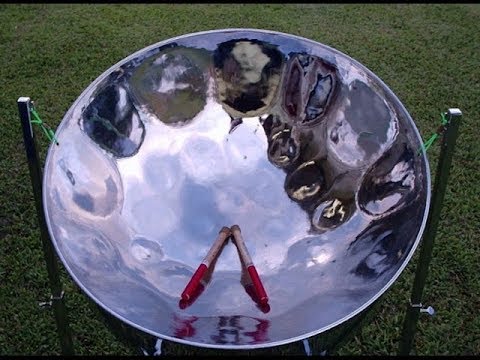
The steelpan is a pitched percussion instrument which was invented in the twin island Republic of Trinidad and Tobago in the late 1930’s (roughly 1938, the exact year is unclear). Although the first type of steelpan had a very small range and the notes were barely tuned, the modern pan is standardized, chromatically pitched and played by striking two (or sometimes more) mallets with rubber tips on the surface of the instrument. The size of the rubber and length of the stick is dependent on the type of steelpan that is being played.
Tenor steelpan. Image courtesty of Augustus Peters Steelpans.
Made from a 55-gallon oil drum, there is a rigorous process that goes into making a steelpan which only trained professionals can handle. Each instrument takes around 40 hours to complete, from the initial sinking, to shaping, tuning and if needed, chroming the drum.
Although it is sometimes referred to as the “steeldrum” the correct term is “steelpan” because it is an idiophone which by definition means that it creates sound through the vibration of the instrument itself when struck. “Steelpan” is also the term that is used in its country of origin and by the founding fathers of the instrument. It is derived from the slang term of calling it a “pan”, which refers to its bowl shape, jokingly referring to its resemblance to the cooking tool.
The steelpan is the national instrument of Trinidad and Tobago and has now become a worldwide phenomenon as it has found a place as a globally recognized instrument, including the United States, England, France and Japan, to name a few. As the only acoustic musical instrument to be invented in the 20th century, the steelpan is still relatively young and though it has greatly evolved, there is still a lot more room for growth and development.
As the current pandemic continues to rage around the world, countless individuals are turning towards creative expression as a way to find a fulfilling use of their time. The resulting products of these artistic expeditions have been astounding, particularly in the steelpan community. The inception of a new podcast in May 2020, All Things Pan, is no exception, with its episodes sure to be delighting pan lovers for years to come.
New episodes stream on Instagram Live each Monday at 5 PM PST and are available afterward to view at any time on IGTV. During the show, host and self-taught pannist Danielle George sits down with a wide variety of guests as they relay their experiences to her audience, making fascinating stories from the pan community easily accessible on a global scale. With the goal of each episode to really get to know each guest, the podcast feels quite personal and casual, giving it a home-like feel.
Host of All Things Pan Podcast, Danielle George
PAN Magazine sat down with Danielle to ask her a few questions about her show, life, and involvement with pan. You can check out the interview below and her podcast HERE.
PAN Magazine:How did you get started with pan? I see that your bio says you started at the age of seven in Edmonton and have over 30 years of experience playing and arranging pan, along with being a band leader for Trincan Steelband.
Danielle: “My dad started a band here in Edmonton with a few of his friends called Trincan Steel Orchestra. When I was young I would always play around with the pan he had at the back of the store my parents used to own. He taught me a song and he noticed how fast I learned it. Since then, I’ve been playing with the band.”
PAN Magazine: How did you come up with the idea for All Things Pan?
Danielle: “It happened during quarantine. I noticed that there weren’t any outlets for pannists to really express themselves: a space for them to talk about how much they love the instrument and have people actually get to know them in a different light.”
PAN Magazine: What is your goal for this podcast?
Danielle: “My goal is to have a place for pannists, tuners, builders, and pan enthusiasts to come together and share their experiences within the pan fraternity.”
PAN Magazine: What do you hope pan enthusiasts get out of your podcast?
Danielle: “I would like pan enthusiasts to really get to know their favorite pannists, arrangers, pan tuners or pan builders – why they perform the way they do, who influences them, how they got involved with steel pan and why. I feel like I’m achieving it because at the same time I’m learning right along with them.”
PAN Magazine: Who are your biggest influences in pan and how have they influenced you, musically or otherwise?
Danielle: “My dad and Len “Boogsie” Sharpe, but over the years many Pannists and arrangers have influenced me in some way. As for music I love my R&B, calypso and soca. But, I try to listen to everything at some point to understand music more.”
PAN Magazine: What kind of feedback have you received from the pan community in general?
Danielle: “The feedback has been amazing. I’ve been receiving so much support from everyone, it just let’s me know I’m on the right path.”
PAN Magazine: What’s been the most difficult aspect of running the podcast so far?
Danielle: “I think the most difficult part is working with Wi-Fi. Technology always has its moment when it wants to work against you.”
PAN Magazine: Who is your favorite pannist/arranger and how has that influenced how you approach all you do in pan, from playing to podcasting?
Danielle: “Favorite pannist/arranger….that’s a hard one to answer because I don’t have just one. I honestly gain a new favorite the more I do this podcast. I could always say Duvone Stewart, Dr. Len “Boogsie” Sharpe, Dr. Jit Samaroo and Johann Chuckaree. But since doing my podcast, I can also add Vanessa Headley, Kern Sumerville, Andre White, Earl Brooks Jr, Sons of Steel, and Dr. Mia Gormandy-Benjamin. I could honestly go on and on. They’ve all taught me so many things but the one thing that they all have in common is to just keep going, just do it, be you, practice makes perfect, and we are all always learning.”
PAN Magazine: What are your hopes for the future of pan and where do you see your podcast fitting into that?
Danielle: “My hope for the future of steel pan what we are all doing right now, supporting each other and collectively pushing steel pan to the future and making the instrument bigger than it needs to be. I hope that my podcast will allow me to travel the world and interview people in the pan fraternity in person.”
Watch all episodes of All Things Pan on Instagram HERE.
Steelpan is an infectious instrument in more ways than one. Not only does its sound turn heads, but it has a way of infusing itself into different cultures in unique ways, undergoing adaptations that its creators could have never predicted.
One such culture is found in the architecturally beautiful streets of what has been called “the world’s smallest big city”: Stockholm, Sweden. Steelpan entered this picturesque Scandinavian stronghold in 1984 through Trinidadian pannists, including world-renowned steelpan builder, tuner, pannist, arranger and composer, Rudy “Two-Left” Smith.
“The band Hot Pans was formed after [local musician] Svenska Rikskonserter had invited Merrytones, a steelband from Trinidad, over to tour Sweden,” said Liz Goulos, six bass player for Stockholm Steelband. “Their instruments were made here in Sweden and left behind after the tour was over. Hot Pans used the Merrytone pans for ten years before acquiring new instruments of their own. They started a steelpan course, which led to the formation of a new band: Cool Pans. The two bands coexisted for a number of years, before joining forces to create Stockholm Steelband.”
Smith built the pans for the band and comes to tune periodically, traveling from his home of Copenhagen, Denmark, where he performs regularly. Most of the band’s tenor pans were purchased from Lawrence “Egar” Mayers in Trinidad.
Circle of Leadership
While most bands have a singular band leader or business manager to help guide their activities, Stockholm Steelband operates as a band of equals, implementing a fully democratic approach to its decision making. “One of our members leads practice sessions and acts as musical director, but we decide our repertoire, projects and other matters by consensus,” Goulos added.
The group is comprised of 15 members. Most are women, with about two players per section; tenor pans are the exception, with five players per section.
Musical selections include traditional steelpan music like soca and calypso in addition to some pop and funk covers. Currently, no original music is played in the band.
Due to the group’s small size, the band relies on outside arrangers to help carry the load of arranging music. Key figures include Rudy “Twoleft” Smith and London natives Steelpan Sam and Delphina James.
Prestigious Audiences
Over the years, the group has played locally at carnivals, festivals, marathons, corporate parties, and, most notably, the Nobel awards ceremony and the Polar Music Prize.
“We were invited to play after the Nobel Banquet the year that Derek Walcott from St. Lucia won the prize for literature. The Polar Music Prize people were keen to have some entertainment for the guests as they arrived on the evening of the grand party,” Goulos said. “We played in the entrance hall at Konserthuset Stockholm when Sonny Rollings won his prize and when Peter Gabriel got his. We also played as a warm-up act at Swedish acclaimed band The Knife’s concert in Stockholm.”
Several members of the group regularly visit Trinidad, with the most recent trip taking place this past February. Their goal is to experience Carnival and gain insight into how large steelbands rehearse and perform. Some of the band’s original members have lived or still live in T&T, and several have been invited to play at Panorama in the large band category.
Playing for Smiles
“The biggest challenges for a steelband in Sweden are finding a niche, an audience and to attract enough musicians who also stay with the band for a long time, since all the numbers we play are head arrangements,” Goulos said. “We make money to cover our rent by playing at corporate parties, outdoor promotions, private parties and other events. Band members are never paid individually – our income goes to cover rent, buying and tuning the pans and fees paid to guest arrangers.”
The band rents a facility in Stockholm that costs SEK 9,500 a month (around $1,100). “We have to play enough gigs to make ends meet. We’re not in it for the money,” Goulos remarked. “We practice once a week, with extra practice sessions for beginners.”
The group hopes to continue spreading good vibes to its listeners with the goal of adding a flavor of steelband music and special rhythms from T&T that brings people together.
“It would be great if it were easier to get a hold of instruments and someone to tune them in our corner of Europe. And, it would be fun to get to know other bands outside of Sweden that we could work with and bounce ideas off of. Stockholm Steelband would love to visit London to rehearse and play with one of the bands during the Notting Hill Carnival, for example.”
With any luck, they’ll get their chance soon enough.
Learn more about Stockholm Steelband on their official website HERE.
Stockholm Steelband
Stockholm Steelband performs “Uptown Funk” by Bruno Mars.
In these unprecedented times, it can be helpful to focus on life’s simple, daily pleasures. For many, that can entail playing or listening to favorite tunes, finding serenity in natural scenery, or experiencing delight from a tasty meal. Whether you are well-versed in the Trinidad and Tobago culinary scene or are just looking to try something new, we have comprised a list of some of our favorite foods for the panyard.
Pholourie
Pholourie from restaurant Mia’s Kitchen in Manhattan Beach, CA
Like many Trini dishes, Pholourie is inspired by Indian cuisine. Fried dough balls are augmented with additives like sweet and spicy mango or tamarind chutney. The dough itself is crafted with split pea batter. This favorite amongst locals is sure to bring a smile to any pan player’s face as a quick, mid-day snack.
Aloo Pie
Aloo Pie, photo by Cooking with Ria
This tantalizing fried dish consists of dough filled with mashed potatoes. The inside can often also contain onions, garlic, and cumin. A frequent find at food stands across Trinidad and Tobago, this meal also takes inspiration from India, with “Aloo” meaning Potato in Hindi.
Benne Balls
Benne Balls, photo by Uncommon Caribbean
These scrumptious Tobagonian delights are an excellent sweet treat to brighten up any pan player’s day. A perfect combination of brown sugar and sesame seed, the resulting balls are the epitome of hard, crunchy satisfaction.
Doubles
Doubles from restaurant Mia’s Kitchen in Manhattan Beach, CA
Doubles is one of the most notable Trini street foods. This tasty sandwich consists of curried chickpeas hugged by two fried flatbreads. Additives can vary, with examples including pepper sauce or green mango pickle. It is often sold in wrapped paper, and while it is traditionally a vegan dish, some vendors may add meat as well.
Bake and Shark
Bake and Shark, photo by The Spruce Eats
Sometimes referred to as “Shark and Bake,” this classic dish is a must-try. Marinated or seasoned bits of shark meat are placed upon a flatbread and anointed with a wide variety of delicious toppings. Additives can include anything from pineapple slices to cucumber to tomato to chutneys. A local favorite, Bake and Shark is sure to satisfy tourists searching for a culinary expedition unlike any other.
Corn Soup
Corn Soup, photo by Greenbowl2soul
Perfect for a cool evening after a long day of practicing with the band, this dish is certain to satiate. The soup is comprised of a light broth, corn cob pieces, carrots, cornmeal dumplings, cassava, green figs, sweet potato, and sometimes pigtail.
“People who love to eat are always the best people.”
– Julia Child
What’s your favorite? Comment below! We want to hear your thoughts!
The steelpan has witnessed a slew of hits in recent years, but fans of the instrument may not be as familiar with its influence on the electronic dance music (EDM) scene. Praised for incorporating unorthodox sounds into pieces, EDM artists, like pan players, are constantly blurring genre boundaries and shattering expectations of what is “acceptable” in music. The following songs have not only showcased the instrument’s versatility but found success propelling it to new heights in mainstream music. Here are our top 5 picks for the best electronic songs that feature steelpan.
1. Love$ick by Mura Masa and A$AP Rocky
This song opens with a simple drum beat and playful piano melody as a backdrop for A$AP Rocky’s rapping. As the song transitions into the pre-chorus, the piano is replaced with steelpan, which continues to be showcased throughout the song. The pan even gets a special feature in the outro, once the vocals are cut. With more than 250 million streams on Spotify, this song has significantly aided in normalizing steelpan in modern music.
Mura Masa - Love$ick (Official Video) ft. A$AP Rocky
2. Better Not by Louis the Child and Wafia
No stranger to the radio, this tune’s bouncing beat and unusual mixture of slightly offbeat synthesizers cultivates a refreshingly new sound. The steelpan, most prominently featured throughout the verse and pre-chorus, only furthers the song’s novelty by giving it a unique tone to complements the experimental melodies in the beat drop. It is no surprise that the “Better Not” has accumulated more than 150 million Spotify streams.
Louis The Child - Better Not ft. Wafia
3. Call me by NEIKED and MIMI
The higher pitched pan chords that complement MIMI’s vocals help cultivate a fun, Caribbean vibe to the tune. The steelpan is woven in seamlessly with a variety of synthesizers – never dominating, but also always making their presence known. NEIKED did an excellent job of highlighting the steelpan instrument’s versatility by substituting it for a space in electronic/pop music usually reserved for piano, synth, or guitar chords.
NEIKED - Call Me (Official Video) ft. MIMI
4. I Got U by Duke Dumont and Jax Jones
Close your eyes and this song will transport you to a seaside vacation. The simple steelpan chord progression, while not always featured throughout the piece, has a significant impact on the overall feel. This song is undoubtedly a dance club classic, with more than 225 million Spotify streams.
Duke Dumont - I Got U (Official video) ft. Jax Jones
5. Broken Drum by Cash Cash and Fitz and the Tantrums
Once more, we see the steelpan replacing the traditional piano or synthesizer chords behind Fitz’s vocals during the verses. While the pan is not as heavily exhibited like the rest of the pieces mentioned, this tune also does an excellent job of showcasing versatility in its use of different instruments. With everything from steelpan to saxophone to a prominent bass to a pounding drum beat, this song melds a multitude of genres seamlessly to produce a hidden EDM treasure.
Cash Cash - Broken Drum feat. Fitz of Fitz and the Tantrums [Official Video]
Three internationally recognized pannists, Tracy Thornton, Dr. Mia Gormandy-Benjamin, and Yuko Asada, have joined forces to unite the global steelpan community through Pan in Unity: an International Virtual Steelband Project.
The project hopes to assemble 1000 global pan players in a virtual medley performance arranged by renowned composer Len “Boogsie” Sharpe. All are welcome to partake, and the process for doing so is simple. Participants need either a pan, percussion instrument, or their voice recorded on video (minimum 1080p). All music scores and note names can be found online HERE, and the deadline to submit is September 8, 2020 at 11:59 PM PST. For further instructions, click the following link: paninunity.com/instructions.
A simplified version of the project is also available for those that do not have time to learn the entire medley but would still like to participate. More information can be found in the Facebook post at the bottom of this article. The music can be found HERE.
More About Pan in Unity
The individuals spearheading this venture have a proven track record of success in similar experiences. For instance, Virtual Steelbands I and II, which exhibited 300 pannists from 11 countries, included Gormandy-Benjamin and Yuko as producers, while the Pan Rocks Quarantine Steelpan, which featured more than 100 pannists from 8 countries, was produced by Thornton. Additionally, Sharpe has collaborated with countless steelbands as a talented performer, composer, and arranger both within the Republic of Trinidad and Tobago and abroad. The project has also partnered with the International Steelband Foundation (ISF) in hopes of increasing engagement from prominent steelbands.
When asked about how his involvement began, Thornton commented that “Everybody just seemed so separated through the world, especially what we’re experiencing here throughout the states. I just thought it was a good opportunity to bring pan players together. [After all], the motto of Trinidad and Tobago is ‘Together we aspire, together we achieve.’” Thornton’s sentiments greatly reflect songs chosen for the medley, such as pieces “One Love” by Bob Marley, “Imagine” by John Lennon, and Trinidad and Tobago classic “Now is the Time.”
The editors at Pan Magazine are extremely excited to stream the finished product – an audio track mixed in with real steelpans – and commend the organizers of Pan in Unity for such an inspiring effort to unite us in these trying times.
Andre White makes a clean sweep of all categories as event returns after 16 years.
In a competition that saw many firsts, from being entirely virtual to its first-ever Japanese pannist, the International Pan Ramajay competition crowned its first triple-crown winner in every category — Andre White.
Pan Ramajay champion, Andre White.
White performed in the solo, duo and quartet categories, wowing the four-person adjudication panel on his way to victory. The International Pan Ramajay competition took place from June 14 thru June 27, 2020 and featured players from all around the world improvising over randomly provided backing tracks of popular songs. The field began with 10 quartets, 15 duos and 44 soloists, eventually ending up with 10 soloists, five duos and five quartets once the Preliminary, Semi-Final and Final rounds concluded.
The performers hailed from 12 different countries, including Trinidad and Tobago, Denmark, USA, Antigua, Barbados, St. Lucia, St. Maarten and Japan. Each performer or group was given a backing track from a select list of songs that included pop tunes “Bridge Over Troubled Water”, “Jammin”, “Rock With You”, and island favorites “Bazodee” and “Ramajay”, among others. The prize money awarded for the solo category was $2,000 U.S. and $3,000 for the duo and quartet categories.
The Field
With a field as competitive and star-studded as one might imagine of a global steelpan competition, White was elated after his victory and grateful for the opportunity to compete against such talented musicians.
Left to right: Iman Pascall, Andre White, Khuent Rosa, and Kareem Thompson.
“It’s a pretty surreal feeling. I didn’t come into the competition expecting to win, really. Especially with the caliber of great players that also took part,” White said. “I just entered because my friends entered and we wanted to have fun showcasing our vibes.”
Maico Miyamoto, the first ever Japanese pannist in Pan Ramajay history.
Competitors included Khan Codice, Domenic Lewis, Kareem Thompson, Keisha Codrington, Kobie Alleyne, Khuent Rose, Maico Miyamoto, Iman Pascall and many others. The competition was judged by four judges, which included Victor Provost, Dr. Eugene Novotney, Professor Liam Teague and Professor Ron Reed.
Good Timing
This year marked the first time Pan Ramajay had been held for 16 years. Republic Bank Exodus hosted the event and has plans for it to return for at least two more years.
“I think the event was fairly well put together. It was the first year that it was done in this capacity (virtually) and for that it went pretty well,” White added. “As with most things, there are always areas that can be improved but I’m sure the organizers would make the right adjustments for the next one.”
The word “ramajay” is a folk term that originated from Trinidad and Tobago and means to let go and break away. Given the context of the event within current times, this could be interpreted as one reason the event and its participants decided to take part. This is especially true when you consider the words of Andre White.
“To be able to present music through the instrument during these dark times means a lot for the progression of the art form. It shows that there are things happening on a global level and will open ideas for people to use other means to push the instrument internationally,” White said. “I hope people get the idea that the only way for us as a steelpan fraternity to move forward is together. Irregardless of your nationality, gender, race, or age. Especially if we want to make it through these times where most of the carnivals (in which the instrument has been most noted to be a part of) have been cancelled going all the way into 2021. The instrument is a tool in which we all can use as a vessel to express ourselves together.”
“I want to share a special congratulations to all the participants the entered the competition with special mention to Khan Cordice, Kareem Thompson, Domenic Lewis, Khuent Rose, Keisha Codrington (and the rest of the codrington family), Kobie Alleyne, Mikhail Salcedo, Eljhaie Brathwaite, Maico Miyamoto, Tristian Japsi, Jahlani Roberts, Domo Joat, and everyone else who made the competition a great one! It was an honor.”
International Pan Ramajay Results 2020:
Soloists
1. Andre White – US
2. Khan Cordice – Antigua and Barbuda
3. Domenic Lewis – Barbados
4. Kareem Thompson – US
5. Keisha Codrington – TT
6. Kobie Alleyne – US
7. Khuent Rose – US
8. Mikhail Salcedo – TT
9. Eljhaie (LJ) Brathwaite – St Thomas
10. Maico Miyamoto – Japan
Duos
Andre White, Tristan Japsi – US
Kareem Thompson, DoMoJOAT – US
Cary Codrington, Keisha Codrington – TT
Khuent Rose, Jahlani Roberts – US
Dejean Cain, Deja Cain – TT
Quartets
Andre White, Kareem Thompson, Khuent Rose, Iman Pascall – US
Steelpan once had a solid foothold in contemporary music. Find out how it’s returned in a unique way.
Since its release in October 2018, the hip-hop/rap hit “Zeze” has elevated the steelpan’s influence to new heights. A year ago, it was not uncommon to come across the tune blasting out of speakers everywhere from bars to clothing stores to a passing car window.
It debuted at #2 on the Billboard Hot 100 and has since racked in more than 500 million Spotify streams, with the steelpan featured throughout the entire song as Kodak Black, Travis Scott, and Offset take turns rapping. However, what many might not know is that when Kodak Black featured a sneak peek of the steelpan instrumental on his Instagram page, the sound’s popularity skyrocketed before the actual song was even released.
Help From A Platform
Tiktok, an application designed to create short videos and used largely by Generation Z, was a primary catalyst for this instrumental snippet’s meteoric rise. Before long, Tiktok creators had incorporated the sound from Kodak’s Instagram as a backing track for their comedic skits, memes, and dance trends.
With assistance from Tiktok’s infamous algorithm, known for its heavy reliance on user interaction indicators, the bright, playful beat amplified excitement in anticipation of the actual track. So much so that upon its initial release, “Zeze” became the most-streamed song in the country. In an interview with Rolling Stone Magazine, producer D.A. Doman commented that “the ‘Zeze’ thing was kind of unheard of, where it’s a beat that’s so big without the song.” The track’s unique path to success highlights the recent changes experienced by the music industry, particularly with the uptick in streaming service use and overnight viral sensations.
Youtube Compilations from 2018 TikTok videos.
Return of Steelpan, Sort Of…
“Zeze” is just one example of how the steelpan has entered modern mainstream hip-hop/rap music. In 2003, rap artist 50 Cent took the rap game by storm with his debut album Get Rich or Die Tryin’, which featured the song “P.I.M.P.” This tune featured a synthesized steelpan sample riff, which became a signature and instantly recognizable hook for the artist. Further, Soulja Boy’s 2007 hit “Crank That (Soulja Boy)” featured a similar riff that helped to make it arguably one of the most recognizable hip/hop songs of its time.
One of the artists featured on “Zeze”, Travis Scott, incorporated a steelpan sample into his 2016 hit “Pick Up the Phone” with Young Thug. Other prominent names like Drake and Rihanna also featured pan in their 2012 hit, “Take Care.” Drake specifically has incorporated more Caribbean influences in recent hits like “Controlla” and “One Dance” on his 2016 album Views.
Mystery Draw Listeners
For many, much of the interest surrounding “Zeze” stemmed from its mystery and unconventionality. Its initial release was devoid of any lyrics, and it was the second track rapper Kodak Black was set to release after leaving prison. The title of the song itself was an uncommon word that many had to look up in order to understand (the word zeze is defined as a stringed musical instrument originating from West Africa).
The song itself, which for many manifests a happy, carefree, summer feel was teased and released in the Fall of 2018. Doman even said himself, “I feel like conventional music industry wisdom would tell you not to put a record full of steel drums out in October.”
Even when speaking with on the song’s composition, Doman refused to disclose whether or not real steelpans were used. “It’s more interesting when people don’t give away how they do everything. It keeps more of a mystique around it,” Doman said. “It’s a lot like Beyonce. Beyonce is not on Instagram Live every day. Don’t get me wrong, some people that works really well for, and it’s super dope, but it also works well for some people to keep more secrecy around themselves. That’s how I like doing things in my production.”
Clearly, Doman was right. His strategy was not only successful in marketing his song but exposing steelpan to Gen Z at a level never before accomplished by the music industry.
MONOMYTH is an intriguing new album by steelpan group, Teddy G and the Groove, that showcases the steelpan artform in an epic progressive rock platform. Using the concept albums of the progressive rock genre as its inspiration, MONOMYTH blends the progressive rock style with contemporary R&B (rhythm and blues), funk, Afro-Cuban, Latin jazz, soca, Afro-Caribbean, and contemporary jazz fusion elements. The result is a hybrid soundscape, rooted in the progressive rock genre, but with an everchanging flow of grooves and styles.
All songs are composed by Ted Goslin (Teddy G), and they feature catchy melodies with interesting lines and riffs, embedded in complex textures and defined by a great variety of instrumentation. In addition to Teddy G on Double Second Steelpans, the Groove consists of Camilo Cedeno on Guitar, Alan Ritter on Drums, Adam Smith on Bass, Tyler Hunt on Percussion, and Ian Holmquist on Trumpet, and their outstanding musicianship is on full display throughout every track of this recording. Especially impressive are the many tasty solos which seamlessly fit the tunes and the styles perfectly.
The band left to right at BIG EGO studios: Camilo Cedeno, Allan Ritter, Ted Goslin (Teddy G), Adam Smith. Not pictured: Tyler Hunt (percussion), Ian Holmquist (Trumpet).
The Hero’s Journey
The album consists of 10 original songs, each of which is intended to represent a different stages of the Monomyth, or The Hero’s Journey, a narrative pattern made famous by Joseph Campbell in his 1949 work, The Hero with a Thousand Faces. Campbell, who was a notable scholar of the work of James Joyce, actually borrowed the term Monomyth from Joyce’s 1939 work, Finnegan’s Wake. In The Hero with a Thousand Faces, Campbell describes the narrative pattern of the Monomyth as follows:
“A hero ventures forth from the world of common day into a region of supernatural wonder: fabulous forces are there encountered and a decisive victory is won: the hero comes back from this mysterious adventure with the power to bestow boons on his fellow man.” – Joseph Campbell, 1949
This narrative pattern serves as the foundation of the album, although none of the songs share titles with the actual names of the stages of The Hero’s Journey as defined in Campbell’s work. The entire album is 33 minutes in length, and of the 10 songs, there are six full-length compositions linked by four short, programmatic interludes.
The interludes are very interesting in scope. “Native Drum” is a very brief atmospheric interlude over a steelpan ostinato with a dreamlike quality. “Flowers in the Storm” is a classically inspired interlude which features a soft electronic rain background pedal point, and is reminiscent of classical guitar literature in its orchestration and texture. “When the Dust Settles” is a Gothic blend of steelpan with an electronic orchestra and choir, and is somewhat reminiscent of a film score soundtrack in its style and orchestration. And “Layover” has a dramatic and dark tone, featuring a descending steelpan phrase, again accompanied by an electronic orchestra in a soundtrack-like texture.
Compositional Analysis
“The Next Room” and “Actions” are both medium-length tunes which blend progressive rock influences with contemporary jazz fusion sensibilities. “The Next Room” features a catchy hook in the chorus with a good mix of major/minor key contrasts and an extensive use of call-and-response motives. “Actions” has a very strong groove with an excellent drum and percussion foundation, and features intricate unison full-band lines and an outstanding steelpan solo.
The remaining four tunes, Wizards, Algorhythmic, Revolt, and Las Cuevas all feature outstanding musicianship and strong compositional ideas.
The opening track, “Wizards”, features a funk-influenced jazz fusion groove with a strong backbeat. It uses a wide variety of textures and layering to create distinct formal sections, and there is a very nice transition back to the head with a soaring guitar solo building on top of a steelpan ostinato and tasty drum riffing.
“Algorhythmic” builds on a hybrid jazz fusion/progressive rock/Afro-Cuban structure, and features an outstanding trumpet solo and a soaring “Byzantine”-influenced ending coda that builds the song nicely to the finish.
“Revolt” has a contemporary jazz fusion/soca feel and features some very stylistic steelpan lines which recognize the steelpan tradition, but have a contemporary flavor. Most notable is an extremely interesting “bridge” section in 6/4 time (with a groove based on a traditional West African 12/8 bell pattern) and featuring uplifting electronic organ chords and cool trumpet riffs.
A Fitting Ending
The album closes with “Las Cuevas”, which is one of the albums strongest compositions. The tune opens with a beautiful chordal texture over a hybrid Afro-Cuban/Afro-Caribbean groove. There is outstanding guitar playing throughout this tune, and especially notable is the distorted guitar solo near the end of the tune which fits perfectly over the transitional chordal structure. Overall this tune features an excellent usage of instrumentation and textural variety throughout, and is a fitting ending to this hero’s journey.
As a whole, the entire album comes across as being genuine, engaging and uniquely familiar, while simultaneously sounding fresh, current and contemporary. It is clear that Teddy G and the Groove put their very best energy into this project, and the results tell their story very well. MONOMYTH stands as a strong example that the steelpan artform is vital and versatile, and it is definitely a project deserving of your full attention.
MONOMYTH is available on all major streaming services including Spotify, Apple Music, Pandora, Deezer, TIDAL, YouTube Music and more.
About the writer: Dr. Eugene Novotney is Director of Percussion Studies at California State University, Humboldt. As a percussionist and composer, Dr. Novotney has performed and presented lectures and masterclasses in North America, South America, the Caribbean, Europe, Asia, and Africa. He has performed on several occasions in Trinidad’s National Panorama Competition, and he has regularly served as an adjudicator for PanTrinbago, the national governing body for the advancement of steelband music in Trinidad & Tobago. Learn more HERE.
Everyone’s got an opinion on their favorite of all time in any medium. But, there are usually a few most people can agree on that deserve to be on a top 10 list. In the steelpan medium, it’s pretty easy to find out who the best of the best are. Join any steelpan related Facebook group and you’ll generally hear the same names repeated a lot.
Whether or not you agree with this list entirely, I’ll make sure it’s clear why each person was chosen. In no particular order, here’s our list of the 10 most innovative steelpan artists of all time.
1. Len “Boogsie” Sharpe
Born Lennox Sharpe, “Boogsie” is considered to be a living legend, both in his home country of Trinidad and Tobago (T&T) and around the world. With perfect pitch and his bluesy, groove-oriented musical style, Sharpe has achieved cult status in the pan community for writing and arranging countless pieces that many consider modern works of art. His work as an arranger for Phase II Pan Groove has made them one of the most famous steel bands in the world, having won Trinidad & Tobago Panorama seven times and second place 12 times. His composing and arranging skills are matched by his dazzling virtuosity as a soloist, given his ability to play incredibly fast and create rich, harp-like pieces by self-accompaniment. Some of his most popular songs include “Sarah,”“Cryin,”“Woman is Boss,” “Pan Rising,” “‘Dis Feelin’ Nice,” “More Love,” “Birthday Party,” and his arrangement of “Fire Down Below” for the 1989 Panorama competition.
"More Love" - Phase II Pan Groove (2013 Panorama Large Band FINALS)
2. Jit Samaroo
Known lovingly by friends, family and fans as “Dr. Jit”, Samaroo was born in Surrey village, in Lopinot, Trinidad and Tobago as the seventh child in a family of thirteen. At the age of 10, he joined the Village Boys pan-round-the-neck group. By 14, Samaroo was fully immersed in steelpan and had mastered how to play every instrument in the steel orchestra. He began arranging for the Lever Brothers’ Canboulay Steelband and eventually took over Renegades Steel Orchestra. This path set him up to become one of the most prolific and successful arrangers of all time. His sound incorporated elements of classical music, with complex countermelodies and syncopation incorporated throughout the arrangements by the guitar and double second sections. Under Samaroo’s direction, Renegades won Panorama nine times. He also gained notoriety for leading his family band, The Samaroo Jets, to victory in Pan is Beautiful IV. Some of his most popular arrangements include “Iron Man,” “Mystery Band,” “Pan Rising,” “The Bee’s Melody,” “Guitar Pan,” “Pan in A Minor,” and “Somebody.”
Len "Boogsie" Sharpe's "Pan Rising" by The Samaroo Jets
3. Ray Holman
Known for his “sweet” steelpan sound, rich harmonies and no-nonsense approach to the artform, Holman has earned a reputation as someone seeking to constantly push the steelpan to new heights. As the first person to write an original piece for Panorama with Pan On the Move in 1972, Holman broke down a barrier previously thought to be taboo as only sung Calypsos were arranged for the competition before that. His work led many others to write original pieces for the contest, including Pelham Goddard and “Boogsie” Sharpe. Holman’s musical style is characterized by having long, flowing melodic arcs with complex chord progressions supporting underneath. Popular pieces he wrote or arranged include “Penny Lane,” “Pan on the Move,” “Pan Woman,” “Carnival Woman,” “Panic,” “Queen of the Bands,” “We Just Can’t Go On Like This,” “Celebration,” “Suzie,” “Playa Larga,” and “My Band.”
Ray Holman checking his new set of Dunleavy Double Seconds
4. Ken “Professor” Philmore
Known for his fast-paced arrangements, exciting solo playing and positive demeanor, “Professor” enhanced the steelpan movement through his innovative style with arrangements like “Pan by Storm,” “Pan Ecstasy,” “Pan in the Party,” “Woman on the Bass,” and “Carnival is We.” As the arranger of Fonclaire Steel Orchestra, Philmore led the group to victory at Panorama . But more so, he gave the band and its Southern region notoriety as traditionally, the top bands come from the Northern region of Trinidad, near Port-of-Spain. He was also the chief arranger and composer for the popular album, Pan Jazz ‘N’ Calypso, and a popular clinician and visiting performer for many universities around the globe. Sadly, he died in 2018 due to complications from a car accident.
Ken "Professor" Philmore Showtime At The Apollo
5. Andy Narell
Narell fell in love with pan at a very young age. His father, New York social worker Murray Narell, was instrumental in bringing famed builder and arranger Ellie Mannette to the United States in the 1960s. Narell remained continuously inspired by his friend and collaborator Mannette as he built a career as a producer, composer, recording artist, session musician, and educator.
He has performed and recorded with a wide array of artists, including Bela Fleck and the Flecktones, Sakesho, The Caribbean Jazz Project (with Dave Samuels and Paquito D’Rivera) and was the first foreign arranger to arrange for Trinidad Panorama in 1999 with Skiffle Bunch performing his original tune, “Coffee Street”. Other popular pieces by Narell include “The Hammer,” “Hannibal’s Revenge,” “Iso’s Mood,” “We Kinda Music,” “Little Secrets,” “Kalinda”, and “The Songlines.”
PANCH Andy Narell Project 2013: Solo by Andy Narell
6. Liam Teague
Nicknamed “The Paganini of Pan,” Professor Teague is regarded as one of the most gifted pannists thanks to his virtuosity, hand speed, and versatility in the number of musical styles he can execute with ease. From jazz to calypso to classical, Teague has composed a number of popular pieces that are performed throughout the world by soloists, small groups, and large steel orchestras alike. Some of his most popular pieces include “Chant,” “Panoramic,” “Hands Like Lightning,” “Cell O Vibes,” and “A Visit to Hell.”
He has arranged consistently for Silver Stars Steel Orchestra in Trinidad and Tobago, with his challenging and exciting arrangements landing his band in the finals year after year. He is Professor of Music and Head of Steelpan Studies at Northern Illinois University (NIU), where he also directs the renowned NIU Steelband. Teague is also the recipient of an NIU Presidential Research, Scholarship, and Artistry Professor Award. He has received many awards from his homeland of Trinidad and Tobago, including the Humming Bird National Award (Silver) and the Ansa McAl Caribbean Award for Excellence.
Born in Laventille, Trinidad, the birthplace of pan, Greenidge has become a household name in his home country and around the world as a member of Jimmy Buffett’s Coral Reefer Band and the instrumental group, Club Trini. Possibly the most recorded pannist in history with regard to appearing on chart-topping pop albums, Greenidge has been featured on albums by Earth Wind & Fire, Ringo Starr, Carly Simon, and on hit singles that include “Just the Two of Us,” by Grover Washington Jr. and “Beautiful Boy (Darling Boy)” by John Lennon. Despite his commercial success, Greenidge has continued to work in Trinidad and Tobago, including carnival for Panorama, where he won twice with Desperadoes Steel Orchestra in 1991 (“Musical Volcano”) and 1994 (“Fire Coming Down”), both original compositions.
Robert Greenidge Steel Pan Solo
8. Ellie Mannette
Known to many as “Father of the Modern Steelpan Instrument”, Mannette is one of the founding fathers of pan, having been there at its inception. What he is most known for is his continuous innovation with the instrument, having pushed the boundaries of what was possible time and again throughout his illustrious career. Legend suggests that Mannette was the first person to use a discarded oil barrel to build a steelpan. Before that, smaller objects, such as biscuit tins and soapboxes, were used; however, they lacked the full range of notes required to make up a chromatic instrument.
As the pan developed, Mannette was credited with the invention of several instruments in the steelpan orchestra, including the Invader Lead (Soprano), Double Second (Alto), Quadduet (Baritone), Triple Guitar (Baritone), Cello (Baritone), Tenor Bass, and Six Bass. He brought his talents to the U.S. in the 1960s, to develop the U.S. Navy Steel Band. Later on, he transitioned to working with inner-city bands in New York City. He freely taught his building skills to an army of apprentices at universities all across the U.S., helping to usher in a renaissance of school steel bands throughout the country.
Mannette was also a prolific pannist, arranger and bandleader, having formed his own band in the late 30s, The Oval Boys, traveled to Great Britain with TASPO (Trinidad All Steel Percussion Orchestra) in 1951, and recorded several albums in the 1960s with his band the Shell Invaders, which still exists today. He received the National Heritage Fellowship Award from the NEA in 1999, the Chaconia Medal from Trinidad in 2000, for being inducted into the Percussive Arts Society Hall of Fame in 2003, and for having his work showcased at the Smithsonian Institution. He died of natural causes in 2018.
Ellie Mannette - 'I Did It My Way'
9. Othello Molineaux
One of the first to use steelpan in the jazz medium, Molineaux gained notoriety for his work with legendary bass player, Jaco Pastorius, from his Word of Mouth jazz fusion group. Molineaux also worked with big names in jazz and pop such as Monty Alexander, Chicago, and David Johansen. Albums he collaborated on included Ivory & Steel with Monty Alexander, Chicago X with Chicago, and collaborations with Jaco Pastorius on 13 albums. These projects included the mysterious Holiday for Pans, which was left unfinished when Warner Bros. refused to continue funding after deeming it too “esoteric” for mainstream audiences. The album has developed a cult following since and is currently for sale with some additional tracks not previously meant to be included on the album. Some of Molineaux’s most recognized works include John and Mary, Opus Pocus, Good Morning Anya, She’s Leaving Home, Happylypso, and his original album, It’s About Time, featuring Hannibal’s Return and Horatio.
Jaco Pastorius & Friends "The Chicken" [Live in Montreal Jazz Fest 1982]
10. Tony Williams
As one of the steelpan’s pioneers along with Ellie Mannette, Winston “Spree” Simon and Neville Jules, Williams began his career in the 1940s. He developed the Spider Web tenor pan, one of the most commonly used designs still used today by steelbands around the world. He was one of twelve panmen selected to join TASPO (Trinidad All Steel Percussion Orchestra), which went to the 1951 Music Festival of Britain in England. Williams worked in different bands before taking over leadership of the Pan Am North Stars, where he made a mark as a leader, pan tuner, and arranger of the band. The band won Panorama twice, in 1963 and 1964. Popular arrangements include “Voices of Spring,” “Moon River,” “Hold On To Your Man,” and “That Happy Feeling.”
Pan Am North Stars - Hold On to Your Man & Mama Dis Is Mas
Did we miss anyone? Be sure to reach out in the comments section and let us know who we should have included.